Fries, chocolate, beer, and waffles. If you’ve already started planning a trip to Brussels, there’s a good chance those four words appear somewhere on your to-do list. But reducing Belgian food to that quartet is a bit like summing up the Grand-Place as a pretty cobbled square. Belgian cuisine is generous, rooted in centuries of Flemish and Walloon tradition, and full of surprises for those willing to dig a little deeper.
From mussels simmered in a creamy sauce to crispy grey shrimp croquettes, through comforting stoemp and speculoos that perfumes every morning coffee, each dish tells a story about Brussels. Brussels is internationally recognized as one of Europe’s great gastronomic capitals, and all it takes is stepping through the door of a historic brasserie to understand why. This guide takes you through ten Belgian specialities to absolutely try during your visit to Brussels and the Grand-Place, with a few tips to make sure you don’t miss the best of it.
Belgian Fries and the Secret of Double Frying
Everyone thinks they know Belgian fries. In reality, few people know what actually sets them apart from their foreign cousins. The secret lies in double frying. Belgian fries in Brussels are first submerged in beef fat at a moderate temperature to cook the inside, then removed and plunged back in at high heat to achieve that characteristic golden, crispy crust.
This technique, passed down from generation to generation in Belgian chip shops (fritkot), is what makes all the difference. In Brussels, the fritkot is as much a social institution as it is a food stand. Locals queue up, choose their sauce with care, and eat their cone of fries standing in the street. It’s a ritual in its own right.
Homemade mayo is the classic choice, but other sauces have their loyal followers too. If you’re not sure what to order, ask the regulars: it’s rarely a bad strategy.
If you’d prefer to enjoy your fries in a more relaxed setting, you can order a cone right here, to eat on the terrace facing the Grand-Place or inside. A simple, authentic way to start your Brussels visit on a solid culinary footing.
The Brasserie Classics You Absolutely Must Try
Belgian brasseries are an institution in Brussels. Not quite restaurants, not quite pubs, but something in between: places where you take your time, where the menu blends traditional dishes and local classics (carbonnade, waterzooi, vol-au-vent), and where beer accompanies a meal as naturally as wine does elsewhere. The dishes below are the ones you’ll almost always find on the menu, and the ones you’d be sorry to skip.
Mussels and Fries: the Duo That Says It All
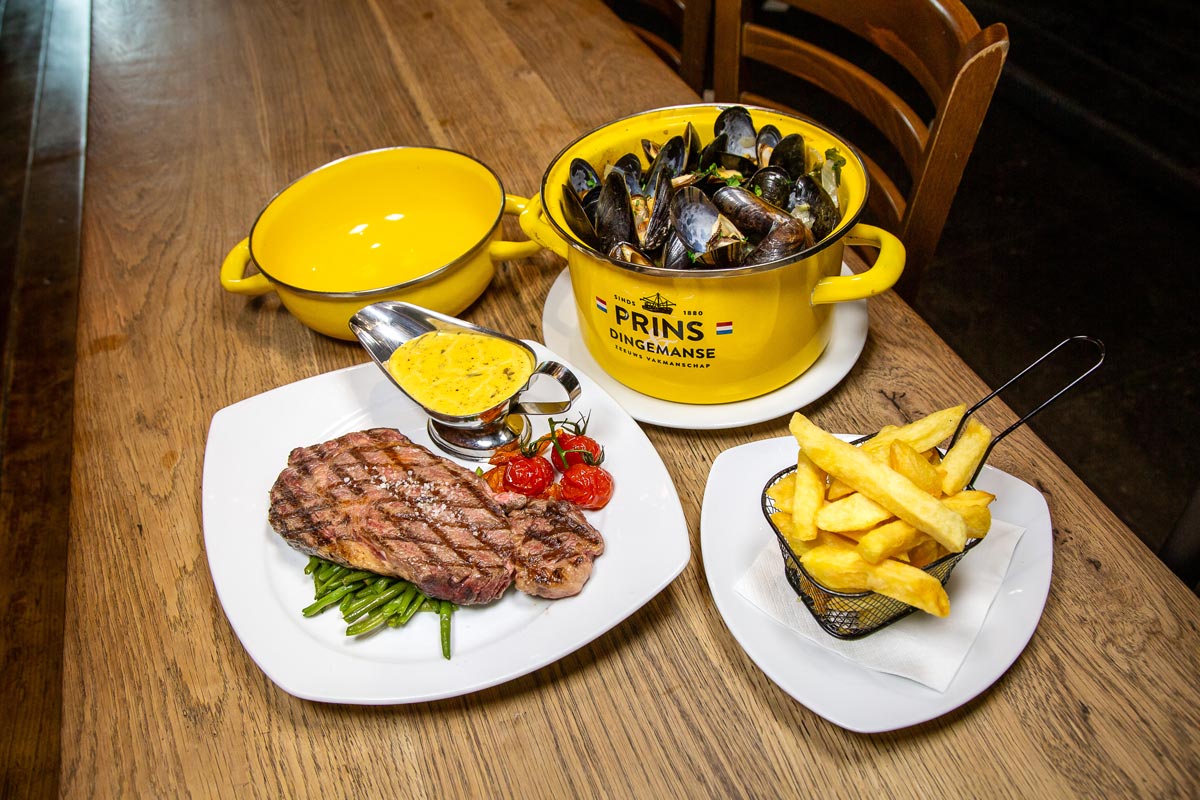
Mussels and fries are the embodiment of Belgian food philosophy: simple ingredients, careful execution, and a result that far exceeds the sum of its parts. The mussels served in Brussels are typically Zeeland mussels, prized for their size and briny flavor. They arrive at the table in a large steaming pot, accompanied by a generous portion of fries.
The most popular version is marinière, made with white wine, shallots, celery, and parsley. But Brussels menus often offer around a dozen variations: with cream, garlic, Roquefort, or beer for a more local and aromatic take. The locals’ top tip: dip your fries in the cooking broth. A small habit that changes everything.
Mussel season generally runs from July to April, with quality peaking in autumn. Outside that window, you’re better off ordering something else.

Carbonnade Flamande: the Beer-Braised Beef Stew
Carbonnade flamande (or stoofvlees in Dutch) takes its name from the charcoal over which it once simmered for hours. It’s a beef stew braised in Belgian dark beer, with onions, thyme, bay leaves, and a touch of sweetness from brown sugar or Liège syrup (a thick, dark fruit syrup). Some recipes add a slice of gingerbread spread with mustard, placed on top of the meat during cooking: it’s what thickens the sauce and gives it that slightly caramelized flavor.
It’s a dish that takes patience, often prepared the day before and left to improve overnight. A brasserie that puts it on the menu is making a serious commitment. Served with fries or stoemp (see below), it’s the kind of comforting dish you particularly appreciate when temperatures drop. Honestly though, it’s hard to resist even in the middle of summer.
If you’d like to discover the authentic recipe for carbonnade flamande, along with our preparation tips, we invite you to read our dedicated article. And if you’re passing through the Grand-Place, don’t hesitate to come and try ours.

Vol-au-Vent: Brussels’ Best-Kept Secret
A quick note on terminology: in Belgium, it’s called “vol-au-vent,” not “bouchée à la reine.” And the difference isn’t just a matter of names. The Belgian vol-au-vent is considerably more generous: served in a large puff pastry shell (a hollow, golden pastry case), it’s filled with chicken, mushrooms, meatballs, and a rich, velvety sauce. It’s a dish that impresses every time, even those who’ve had it before.
Bruxellois are so attached to it that the city organized its first competition in 2025 to crown Brussels’ best vol-au-vent. Organized by the non-profit BXLove and chaired by Brussels chef Christophe Hardiquest, the competition brought together around twenty restaurants in May 2025. We took home the bronze medal and the People’s Choice Award at this inaugural Brussels edition, a proud recognition for a 100% homemade vol-au-vent, prepared without veal sweetbreads and designed to suit all tastes.

Grey Shrimp Croquettes: the Pride of the Belgian Coast
Grey shrimp croquettes are probably the most underrated Belgian speciality among visitors, and one of the most loved by locals. They were born on the Belgian coast, in Ostend, where fishermen brought in small grey shrimp from the North Sea every day: smaller than tropical shrimp, but far more flavorful, with a firm texture and a delicate briny taste.
The recipe involves mixing them with a thick, well-seasoned béchamel, shaping the mixture into croquettes, breading them and frying until the crust is golden brown. The inside should be molten, almost creamy. It’s this contrast in textures that makes them irresistible. They’re served as a starter, with a wedge of lemon and fried parsley.
A word of caution: some tourist restaurants serve industrially prepared croquettes, often made with frozen shrimp from distant waters. For an authentic experience, look for a brasserie that makes them in-house, which is exactly what we do.

Stoemp: Brussels’ Ultimate Comfort Food
Stoemp is a deeply Brussels speciality, born in the 19th century in the city’s working-class kitchens. It’s a mashed potato dish mixed with seasonal vegetables (carrots, leeks, spinach, or Brussels sprouts), flavored with thyme and bay leaves. Served with a grilled sausage or lardons, it’s the ultimate everyday dish: budget-friendly, filling, and genuinely good.
You might call it grandmother’s cooking, and that’s meant as a compliment. Stoemp doesn’t try to impress, it simply comforts. If you spot it on a Brussels menu, it’s usually a good sign about the kitchen.
A Brussels Classic: Chicons au Gratin
“Chicon” is the Belgian name for endive, a word Belgians almost never use themselves. Cultivated in Belgium since the 19th century, this mildly bitter vegetable has become one of the country’s most emblematic, and chicons au gratin are without doubt its most popular preparation.
Chicons steamed or boiled, wrapped in a slice of ham, smothered in a creamy béchamel and gratinated in the oven with grated cheese. The result is a warm, generous dish, with that subtle bitterness of the endive hiding beneath all that creamy richness. It’s the kind of dish Bruxellois eat at home on a Sunday evening, and one they’re proud to have you try.
Chicons au gratin is a seasonal dish, typically found on menus from autumn through early spring. If you’re visiting Brussels in summer, your chances of finding it are slim. But if the season is right, it’s a genuine way to discover Brussels cuisine at its most sincere.
Brussels’ Sweet Temptations
Belgian food isn’t just about savory dishes. It’s also, and perhaps above all, about sweets. Waffles, pralines, speculoos: three classics whose simple appearance conceals a richness of tradition and craftsmanship well worth exploring.
The Brussels Waffle, and Why It’s Nothing Like the Liège Waffle
It’s a common source of confusion, and it matters. Belgian waffles come in two very distinct varieties: the Brussels waffle on one side, and the Liège waffle on the other. The Brussels waffle is rectangular, light, and airy. Its leavened batter gives it a crispy exterior and a soft interior, and it’s traditionally eaten plain or with whipped cream and fresh strawberries.
The Liège waffle is smaller, irregularly shaped, denser and sweeter, with pearl sugar that caramelizes during cooking to create small, crunchy pockets. It’s often eaten straight off the stand, no topping needed, because the flavor speaks for itself.
In Brussels, both are easy to find in the city center. Be wary of stands selling pre-made waffles reheated to order: a Brussels waffle fresh off the iron is in a league of its own. For the record, the Brussels waffle is thought to have first appeared around 1842, with its traditional recipe calling for around twenty pockets.

Belgian Chocolate and Pralines: a Time-Honored Passion
Belgium is home to around 300 artisan chocolatiers and more than 2,000 chocolate shops across the country. Those figures give you some idea of the place chocolate occupies in Belgian culture. But what truly sets Belgian chocolate apart on a global scale is the invention of the filled praline by Jean Neuhaus Jr. in Brussels in 1912: a chocolate shell encasing a creamy filling (praline, ganache, or caramel). A revolution at the time, an absolute classic today.
In Brussels, the concentration of chocolatiers around the Grand-Place can quickly feel overwhelming. A few pointers to help you navigate:
- Major brands like Godiva, Leonidas, and Neuhaus rank among the most celebrated Belgian chocolatiers in the world, with easily visible shops throughout the center.
- For a more artisanal experience, names like Pierre Marcolini or Laurent Gerbaud are well worth the detour.
- A good chocolatier shows it in several ways: no vacuum-sealed industrial packaging on display, a short ingredient list, and staff who can talk knowledgeably about where their cacao comes from.
Speculoos: Far More Than a Coffee Biscuit
Speculoos is one of those products that almost everyone has tasted without necessarily knowing it’s Belgian. This dry, slightly crunchy biscuit, spiced with cinnamon, cardamom, nutmeg, and cloves, was born in Belgium in the 17th century. It’s traditionally served with coffee, but also finds its way into desserts, spreads (in paste form), and even some savory recipes.
In Brussels, Maison Dandoy, founded in 1829, stands as the uncontested benchmark. Their speculoos are made to a traditional recipe and sold individually or in decorative tins that make excellent souvenirs. Hard to leave empty-handed.

Which Belgian Beers Pair Best with Belgian Food?
Belgian beer isn’t something you just drink: it’s something you choose. With more than 400 active breweries in Belgium and hundreds of different styles, beer here plays the role that wine plays in France, a considered pairing, adapted to the dish. It’s no coincidence that Belgian beer culture has been on UNESCO’s Intangible Cultural Heritage list since 2016. Discovering Belgian beers at the table is also discovering a typically Belgian way of eating.
When it comes to pairing Belgian beers with Belgian food, a few combinations work particularly well. Here’s a quick guide:
- Witbier (white beer): with mussels and fries and grey shrimp croquettes. Light and slightly tart, it doesn’t overpower the seafood flavors and refreshes the palate between bites.
- Amber beer: with carbonnade flamande and vol-au-vent. Fuller and maltier, its caramel notes naturally echo the flavors of the dish.
- Lightly roasted dark beer: with chicons au gratin and stoemp. Its depth provides a welcome contrast to the richness of the sauce.
- Lambic or gueuze: best appreciated on their own, or alongside simpler dishes. These spontaneously fermented beers, unique to the Brussels region, are slightly tart, complex, and often surprising to first-timers.
We offer around forty Belgian beers, with about ten available on draft. Plenty to explore the major styles over the course of a meal, with staff on hand to help you find the right pairing.
Tips for Getting the Most Out of Belgian Food in Brussels
A few practical pointers for food lovers looking to explore the best Belgian specialities in Brussels’ historic center. Discovering Belgian cuisine in Brussels takes a little effort: here’s how to avoid the tourist traps and taste the real thing.
- Tell the good from the bad: the streets around Brussels’ Grand-Place are home to as many great addresses as tourist traps. A menu translated into ten languages, laminated photos at the entrance, and a waiter calling you in from the pavement are all red flags. Before picking a restaurant, check whether the dishes are made in-house and whether the menu changes with the seasons. That’s the clearest indicator of a kitchen that takes its craft seriously.
- Match your order to the season: Belgian cuisine is deeply seasonal. Mussels are best from July to April, chicons au gratin is an autumn and winter dish, and white Belgian asparagus appear in spring.
- Don’t skip the starters: grey shrimp croquettes year-round, maatjes (fresh marinated herring served with onion and pickles), or a proper onion soup in winter are all examples of starters you’d be sorry to pass over in favor of going straight to the main course.
- Allow yourself time: eating Belgian-style isn’t a twenty-minute affair. A Brussels brasserie is meant to be savored at the pace of a long lunch or a dinner that stretches into the evening. That’s the spirit in which the food is cooked, and that’s how it’s best enjoyed.
FAQ: Your Questions About Belgian Specialities in Brussels
- What is the most typical culinary speciality of Brussels?
- It’s hard to pick just one, but if pressed, mussels and fries remain the most iconic dish of Brussels and Belgium in general. Accessible, generous, and deeply rooted in local culture, they appear on almost every brasserie menu in Brussels. Stoemp, carbonnade flamande, and grey shrimp croquettes are other unmissable classics during a visit.
- What is the difference between the Brussels waffle and the Liège waffle?
- The Brussels waffle is rectangular, light, and crispy, with a leavened, airy batter. The Liège waffle is smaller, irregularly shaped, denser and sweeter, thanks to the pearl sugar that caramelizes during cooking. Both are easy to find in Brussels, but a Brussels waffle fresh off the iron is an experience in its own right.
- What is Belgian stoemp?
- Stoemp is a typically Brussels dish made from mashed potatoes mixed with seasonal vegetables (leeks, carrots, spinach, or cabbage), flavored with thyme and bay leaves. It’s usually served with a grilled sausage or lardons. A traditional Belgian dish, popular, filling, and comforting, born in the 19th century in Brussels’ working-class kitchens.
- Where to eat authentic Belgian food near the Grand-Place?
- Le Roy d’Espagne, located at number 1 on the Grand-Place, offers a menu of Belgian specialities made in-house: mussels and fries, carbonnade flamande, vol-au-vent, grey shrimp croquettes, stoemp and many other classics. The restaurant took home the bronze medal at the first Brussels vol-au-vent competition in 2025, organized by the ASBL BXLove.
- Which Belgian beers go best with a meal?
- It depends on the dish. A witbier pairs well with seafood and grey shrimp croquettes. An amber beer works beautifully with carbonnade flamande or vol-au-vent. A lightly roasted dark beer complements sauced dishes like stoemp or chicons au gratin. Lambic and gueuze, spontaneously fermented beers from the Brussels region, are also worth trying for their unique character.
- What exactly are grey shrimp croquettes?
- They’re a Belgian speciality that originated on the Belgian coast, in Ostend. North Sea grey shrimp, smaller and more flavorful than tropical shrimp, are mixed with a thick béchamel to make the iconic grey shrimp croquettes of Belgian cuisine, then breaded and fried. The inside should be molten and creamy, the crust golden brown. Served as a starter, with a wedge of lemon and fried parsley.
Conclusion
Belgian food isn’t a checklist of dishes to tick off. It’s a way of taking your time, sitting down without watching the clock, letting conversation stretch as long as the beer stays cold. Every speciality in this guide has its own story, its own devotees, and sometimes its own regional debates. Trying them in Brussels, right in the heart of the Grand-Place, is placing them back in their natural setting.
Here at Le Roy d’Espagne, our menu is rooted in these traditions, with dishes made in-house and a selection of Belgian beers to go with them. If you’re not sure where to start, ask your server: it’s often the best guide there is. And if you leave already looking forward to coming back, that means Brussels has done its job.