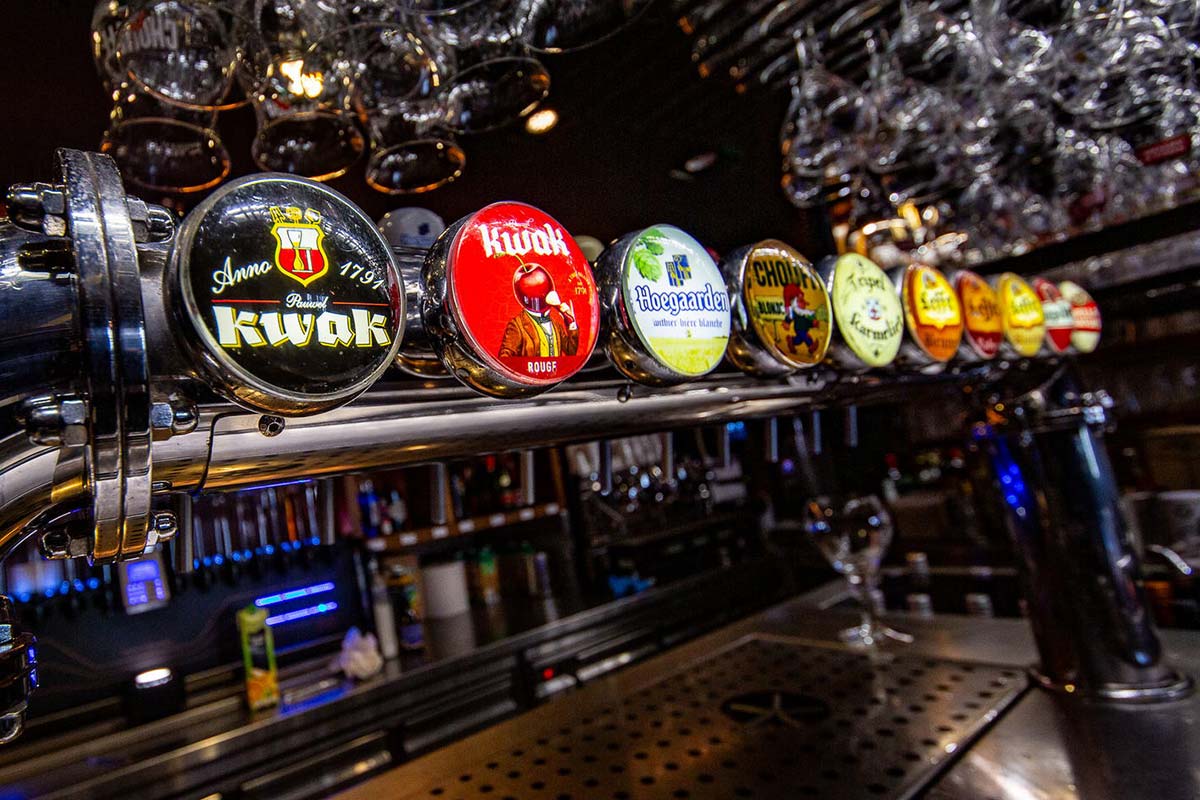
When UNESCO added Belgium’s beer culture to its Representative List of the Intangible Cultural Heritage of Humanity on November 30, 2016, it simply confirmed something every beer lover already knew. Belgium isn’t just a country that makes beer; it’s a country where beer has become a shared language of its own. Belgian beers, breweries, and beer culture are so woven into daily life that they’ve become inseparable from Belgian identity, bridging Walloons, Brussels residents, and Flemish people alike in what locals proudly call belgitude, that singular, slightly offbeat Belgian identity. But the road here was long and often winding, marked by Benedictine monks, imperial decrees, revolutions, world wars, and unexpected revivals. This is the story of a drink that became a civilization, more than a thousand years in the making.
The origins of Belgian beer: how the abbeys built it
Long before beer became what it is today, brewing it was a domestic skill, practiced at home mostly by women. Everything changed in the Middle Ages. Back then, water in towns and villages could often be contaminated, a possible source of feared diseases. Because brewing involves boiling, beer could offer a safer alternative to some of the water available at the time.
That’s where the monasteries stepped in. Brewing had originally been a household chore handled by women, but in the Middle Ages, faced with such poor water quality, monks and abbeys put their extensive agricultural knowledge to work developing something they could drink safely. Monks in southern Europe turned to winemaking, but those in Belgium, where the climate hardly suits grape growing, naturally turned to brewing instead.
As early as the 6th century, monastic communities were offering food and lodging to pilgrims under the Rule of Saint Benedict, and beer became a symbol of hospitality. Starting in the 9th century, Charlemagne pushed to expand abbey brewing, requiring that it be handled exclusively by skilled experts and that every monastery have its own brewery. That edict reshaped the landscape. Abbeys became structured production centers, equipped with technical resources unmatched anywhere in secular society.
Several major Belgian abbeys set up their breweries during this period. Affligem Abbey, from 1086, was reportedly the first to use hops; Grimbergen Abbey had brewing equipment as early as 1128; and the Abbey of Leffe, near Dinant, would later brew the beer of the same name. Beer became a mark of identity, a point of pride tied directly to a monastery’s reputation.
From gruit to hops: the 14th century revolution
For a long time, brewers didn’t have hops as we know them today. Before the 14th century, they used a blend of aromatic plants called gruit, made from heather, bog myrtle, yarrow, and other herbs depending on the region; it balanced the malt’s sweetness but didn’t keep the beer fresh for long. Hops are thought to have spread widely in part thanks to a 1364 decree, issued by Emperor Charles IV, requiring brewers to use them for their preservative qualities. That decree marked a turning point. Hops not only improved shelf life but also brought the aromatic bitterness that would become a hallmark of modern brewing.
Towns also saw the rise of brewers’ guilds, true professional organizations that governed and protected the trade, in Bruges as early as 1303 and in Liège starting in 1357. These guilds set the rules of production, controlled quality, defended collective interests, and fixed prices. In Leuven, the Den Hoorn brewery (the Horn) was founded in 1366; six centuries later, it would become the birthplace of Stella Artois.
This same period also gave rise to the legend of Gambrinus, beer’s mythical patron figure, likely inspired by Jan Primus, Duke of Brabant, who embodies the good cheer and local brewing pride Belgians still celebrate today.
Lambic: a treasure from the Senne Valley
While the abbeys refined their recipes and towns organized production, a distinct tradition was taking shape in one particular corner of the country, the Senne Valley and the Pajottenland, just southwest of Brussels. This is where lambic has been brewed for centuries, using a method found nowhere else in the world, spontaneous fermentation.
In the heart of the Pajottenland, the valley air carries hundreds of specific wild yeast strains, the best known being Brettanomyces bruxellensis and Brettanomyces lambicus. These microorganisms make an extraordinary brewing method possible, spontaneous fermentation, also known as natural fermentation. Unlike other beers, whose fermentation is triggered by adding cultured yeast, the wort is left exposed to the open air in large shallow vats, letting natural microorganisms do all the work.
The result is a beer like no other, dry, wine-like, slightly sour, sometimes described as “wild.” Some sources trace the word lambic back to Lembeek, a village within the spontaneous fermentation production area. Until the mid-19th century, lambic was the only beer brewed in the capital, which at the time was home to more than a hundred small breweries.
From lambic, brewers built out an entire family of beers: gueuze (a blend of young and old lambics that undergoes a second fermentation in the bottle, nicknamed the “champagne of Brussels”), kriek (lambic with cherries), framboise, and plenty of other fruit variations. Since 2017, the “Vieille Gueuze,” “Vieille Gueuze-Lambic,” and “Vieux Lambic” designations have held Traditional Speciality Guaranteed (TSG) status from the European Union, protecting these beers’ centuries-old brewing methods.

The golden age of the Trappists
Abbey brewing dates back to the early Middle Ages, but the strictest branch of all only appeared in the 17th century: the Cistercian Order of the Strict Observance, more commonly known as “Trappist.” Trappists live by the Rule of Saint Benedict, built around the motto “ora et labora” (prayer and work). For them, brewing isn’t a business; it’s a way to support the community and fund its charitable work.
As early as 1595, the monks of Saint-Rémy Abbey, where Rochefort would later be brewed, were already making beer, long before their community joined the Trappist branch. Westmalle Abbey was founded in 1794, but its brewery didn’t open until 1836; the monks sold beer occasionally at the abbey gate starting in 1856, though sales through merchants only began in 1921. The other major abbeys followed over the 19th and 20th centuries: Westvleteren obtained its brewing license in 1839, Chimay started in 1862, and Orval resumed brewing in 1931 in a rebuilt abbey.
The “Trappist” label is tightly regulated. To carry the “Authentic Trappist Product” logo, a beer must meet all three of these conditions:
- products must be made within the immediate surroundings of the abbey
- production must be carried out under the supervision of the monks or nuns
- profits must go toward the needs of the monastic community, solidarity within the Trappist Order, or development projects and charitable works
This legal protection was hard won. Things only started to settle in February 1962, when a Ghent court ruled in the monks’ favor, ending decades of commercial abuse of the word “Trappist.”
Of the eleven officially recognized Trappist breweries in the world today, five are Belgian: Chimay, Orval, Rochefort, Westmalle, and Westvleteren. A sixth Belgian abbey, Achel, lost its Trappist label in 2021 when the monastic community left, leaving no monks to oversee brewing.
Meet Belgium’s five Trappist breweries today
Each has its own personality. Westmalle Tripel, launched commercially in 1934, became the world’s benchmark for the tripel style. Westvleteren 12, brewed in deliberately limited quantities by the monks of Saint-Sixtus Abbey, is regularly named the best beer in the world and is sold only at the abbey, by reservation. Orval, with its instantly recognizable bottle shape and Brettanomyces-driven second fermentation, is the only Trappist beer sold in a single version. Chimay’s beers, more widely available and internationally known, are distinguished mainly by their cap color (red, blue, white, and more recently gold and green). Rochefort, known for its numbered lineup, 6, 8, and 10, with notes of chocolate and coffee, has also recently added the Tripel Extra, a lighter blonde.

Revolutions, wars, and a shattered brewing landscape
The 19th century opened a period of sharp contrasts. Political upheaval came first. The French Revolution, which swept through the occupied Belgian regions, dissolved the brewers’ guilds and led to the closure, and often the destruction, of many abbeys. A good number of monastic breweries vanished outright. Competition from cocoa and soda was also starting to bite.
And yet Belgium still counted around 3,000 breweries in 1900. The industrial revolution transformed brewing methods. Refrigeration, pasteurization, the chemistry of fermentation, and the arrival of pure selected yeast strains (notably bottom-fermenting strains from Germany and Bohemia) ushered in the age of pils, a pale, light, endlessly reproducible beer.
In Leuven, the Den Hoorn brewery was founded in 1366. Sébastien Artois became its master brewer in 1708, then bought the brewery outright in 1717 after nine years running the brewhouse; it was renamed Artois. In 1926, the company created Stella Artois, a bottom-fermented pils stronger than anything brewed there before. Originally conceived as a Christmas beer (hence the name, Latin for “star”), Stella would go on to become one of the most exported pils in the world.
In Jupille, near Liège, the Piedboeuf family followed a similar path. From the early 19th century, the Jupille-based Piedboeuf company sold brewing kettles and vats to Belgian and German breweries. It later moved into brewing itself and, in the 1960s, launched Jupiler, which would go on to become Belgium’s best-selling pils.
But the two world wars hit hard. Copper requisitions, blockades, destruction, and raw material shortages all took their toll, and by the end of the second war, in 1946, only a quarter of Belgian breweries had survived. It was a dramatic collapse, one that could easily have ended the country’s brewing diversity for good.
The revival, from the 1970s to today
Belgian beer found its second wind exactly when no one expected it. The general public rediscovered it in the 1970s. Specialty brewers, who had kept traditional recipes alive despite the dominance of pils, found their audience again. Tasters, journalists, and enthusiasts, in Belgium and abroad, began celebrating the depth and diversity of the country’s brewing heritage.
This revival unfolded on two fronts at once, with massive industrial consolidation on one side and a craft boom on the other. The 1987 merger of Artois and Piedboeuf created Interbrew, which became InBev in 2004 after merging with Brazil’s AmBev, then AB InBev in 2008 following the acquisition of American brewer Anheuser-Busch. That group, headquartered in Leuven, is today the world’s largest brewer. Alongside it, the Alken-Maes group (a Heineken subsidiary) makes up the country’s second industrial pillar.
But the other side of the story is just as remarkable. Since the 1980s, craft beer has boomed. Microbreweries have sprung up everywhere, in small villages and big cities alike, reviving forgotten styles and experimenting with new ones. Nearly 1,500 different beer types are now produced across the country using a wide range of fermentation methods.
That diversity has no real equivalent anywhere else. Trappists, abbey beers, lambics, gueuzes, krieks, witbiers, blondes, ambers, browns, saisons from Hainaut, Flemish old browns, tripels, quadrupels, bières de garde, fruit beers, Belgian IPAs, and every kind of hybrid in between; the range is simply unmatched.

UNESCO seals the deal
That richness eventually earned its official recognition. The news broke on November 30, 2016, in Addis Ababa. Belgium’s beer culture now officially belongs to the Intangible Cultural Heritage of Humanity. Meeting in the Ethiopian capital, UNESCO decided that Belgian brewing culture deserved that recognition.
The listing doesn’t cover a product; it covers a living culture. Brewing and appreciating beer are part of the living heritage of communities all across Belgium, playing a role in everyday life and in festive events alike. UNESCO specifically highlighted the knowledge passed down by master brewers, efforts to prevent excessive drinking, and the industry’s environmental commitments.
Beyond the national pride, this recognition points to something deeper. Beer is one of the few things Walloons, Flemish people, Brussels residents, and German speakers genuinely share. It crosses linguistic and regional lines, bringing people together in estaminets, village breweries, festivals, and cafés. It’s not just something you drink; it’s something you discuss, compare, and pair with local cheeses and dishes, working its way into the kitchen too, in beef stew braised in beer, rabbit cooked in kriek, or Chimay cheese.
A tradition reinventing itself
Today’s Belgian brewing scene sits between two poles. On one side, industrial giants selling millions of hectoliters and exporting Belgian brands to every continent. On the other, hundreds of small craft producers reinventing the classics, working with American hops or mixed fermentation, and reviving regional styles that had all but disappeared.
Somewhere in between sit abbey beers, occupying a particular, sometimes murky, spot. They need to be clearly distinguished from Trappists. Abbey beers draw on monastic tradition but are usually brewed by commercial companies under license. Most of the abbey beers you’ll find on store shelves come from major brewing groups (Affligem, Grimbergen, and others), which means the label “abbey beer” is often little more than a marketing term. To help sort things out, the “Certified Belgian Abbey Beer” label, managed by the Belgian Brewers federation, guarantees at least a historical link to a real abbey and that royalties are paid to it or to its charitable works.
Trappist breweries, by contrast, keep production deliberately limited. The monks steer clear of the race for volume, holding to a principle Westvleteren puts simply: “we brew to live, we don’t live to brew.” That deliberate restraint, swimming against the current of mainstream commercial logic, may be the strongest guarantee of the tradition’s authenticity.
Conclusion: over a thousand years on, what’s next?
From Affligem Abbey in the 11th century to the urban microbreweries of the 21st, from Charlemagne to AB InBev, from medieval gruit to today’s IPAs, Belgian beer has crossed the centuries transforming itself without ever losing its soul. It rests on a paradox. Belgian beer is a craft deeply rooted in local terroir, from the microorganisms of the Pajottenland to the specific yeast strains of each abbey, yet paired with an ongoing openness to innovation and the wider world.
UNESCO’s 2016 recognition of Belgian brewing culture isn’t a finish line; it’s a call to action, to preserve this living culture, pass it on, and defend it against industrial standardization. As long as there are brewers willing to experiment, monks brewing at dawn, enthusiasts who appreciate the complexity of a five-year-old gueuze, and cafés serving every beer in its proper glass, the story of Belgian beer will keep being written. And every sip tells its own small part of that story, more than a thousand years of invention, struggle, patience, and shared pleasure.
FAQ
- Why do Belgians use a different glass for every beer?
- The tradition comes from the idea that every beer has an ideal glass to bring out its aroma and head. Breweries have long supplied their own glassware to cafés, partly for practical reasons (a tulip glass concentrates the aromas, a balloon glass lets a Trappist beer breathe) and partly for branding. Serving a beer in the wrong glass is close to sacrilege in a traditional Belgian café.
- What’s the difference between top-fermented and bottom-fermented beer?
- Top fermentation uses yeast that works at relatively warm temperatures, 15 to 25°C (59 to 77°F), and rises to the surface. It’s the traditional method behind Trappists, tripels, abbey beers, and witbiers. Bottom fermentation, a more recent technique, happens cold, around 10°C (50°F), with yeast that settles at the bottom; it’s how pils beers like Stella or Jupiler are made. Top fermentation tends to produce more complex, aromatic beers, while bottom fermentation gives cleaner, more refreshing ones.
- Why do some Belgian beers clock in at 9 or 10% alcohol?
- According to the most common explanation, “dubbels,” “tripels,” and “quadrupels” get their names from the amount of malt used, though that multiplier was never applied consistently or systematically. The tradition traces back to monastic recipes, where strong beers were brewed for feast days or to help the beer keep longer. Today, that higher alcohol content is simply part of the character Belgian beers embrace, favoring rich flavor over lightness.
- Are there still breweries run directly by monks?
- Yes, but they’ve become rare. In Belgium, only the five current Trappist abbeys (Chimay, Orval, Rochefort, Westmalle, and Westvleteren) brew under the direct control of their monastic community; Achel was also part of that group until 2021, when it lost its label for lack of resident monks. Most other “abbey beers” are produced by commercial breweries under license, with no real monastic involvement.
- What’s the difference between a Belgian witbier and a blonde?
- Witbier, like Hoegaarden, is brewed with a large share of wheat alongside the barley, which gives it that cloudy, milky color and an often citrusy flavor from added coriander and orange peel. Blonde beer mainly uses pale barley malt and offers a cleaner profile, either drier or maltier depending on the recipe. Visually, witbier is instantly recognizable by its hazy appearance, while blonde beer shows off a clear, golden color.
- Why has Belgium kept such brewing diversity while other countries standardized?
- Several factors come together here: strong regional attachment to specific styles (saison in Hainaut, old brown in West Flanders, lambic in Brussels), the absence of a strict purity law like Germany’s Reinheitsgebot, which would have restricted allowed ingredients, and steady local demand that let small breweries survive alongside industrial pils. Demanding, curious Belgian drinkers also played a major role, simply refusing to let their tastes get flattened.
- How is Belgium’s brewing know-how passed down today?
- The craft is passed down through several channels: professional training (Institut Meurice in Brussels has trained internationally recognized master brewers for over a century), family knowledge in multi-generational breweries, and zythology courses (training in professional beer tasting) open to the public. UNESCO specifically praised this system of knowledge transfer as part of its 2016 recognition.


Great historical overview! The deep connection between medieval monasteries and the evolution of Belgian brewing traditions is truly fascinating.