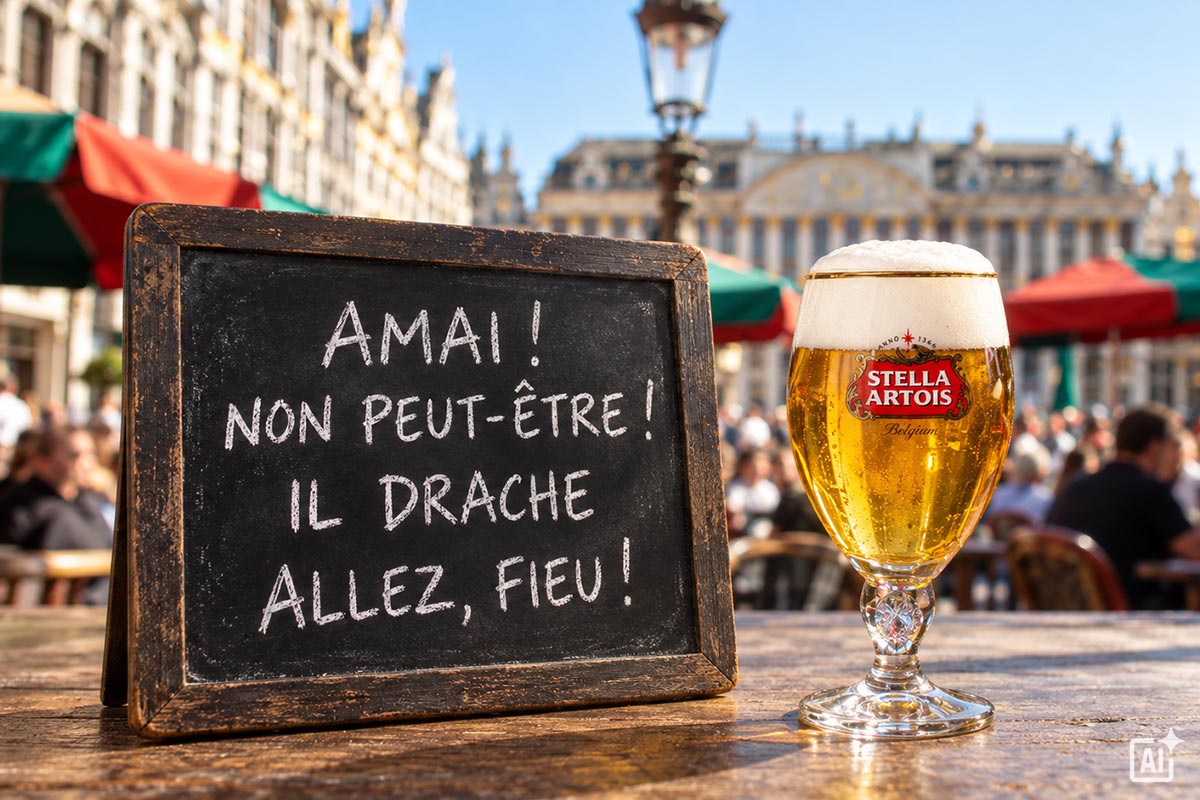
A Brussels word can catch you off guard anywhere in the city, on a café terrace or halfway through a meal. “Amai,” an amused customer blurts out, “fieu,” a waiter answers in the same easy tone, and the visitor who just landed in town starts wondering which language the conversation switched to. Brussels sits right on the line between French- and Dutch-speaking Belgium, and its own local speech, brusseleir, blends the two into something entirely its own, passed down for generations in cafés and home kitchens. Twelve words and expressions are enough to get your bearings, and to understand a little more about the identity of the city you’re about to explore. Here’s how to arrive on the Grand-Place with your ear already tuned in.
Where does Brussels dialect come from?
Before French took over public life, most people in Brussels spoke Brabantian, a Germanic dialect close to Dutch and dating back to the Middle Ages. French, for its part, stayed largely confined to the nobility and part of the upper middle class for a long time. Everything changed when France annexed the region, from 1795 to 1814, and again when Belgium became independent in 1830 and French was named the new kingdom’s only official language. Working-class families in Brussels, who still spoke Brabantian at home, then picked up French in the street, at work, and at school.
Out of that mix grew, over the course of the nineteenth century, several ways of speaking that people today group together under the name Brussels dialect, or brusseleir, ranging from Brussels Flemish, which stays close to Dutch, to beulemans, a French sprinkled with Flemish turns of phrase and vocabulary. The words and expressions below belong mostly to that second family, the one you’re most likely to hear today around the city’s streets and cafés. Its grammar still leans on a Flemish structure, while French vocabulary slips in generously, sometimes fitted with distinctly local endings, as in “autoriseire” for “autoriser,” the local way of saying “to authorize.” It also changes from one neighborhood to the next, which is why ten different Brussels natives might give you ten different definitions for the very same word.
Twelve words and expressions to understand Brussels
Some of these words have carved out a real place in everyday French, so much so that plenty of Brussels natives use them without even realizing they’re speaking dialect. Others stay more low-key, kept mostly for regulars at neighborhood cafés or for family and friends. Here’s a selection of the liveliest ones, the kind you actually have a good chance of hearing during your stay in Brussels.
Zinneke
Zinneke (say “ZIN-uh-kuh”) originally meant a stray mutt, a dog with no particular breed. The most common explanation traces the word back to Zenne, the Brussels name for the Senne, the river that used to run through the city and served as a refuge for the many stray dogs abandoned there. Over time, the meaning drifted from dog to human, becoming the name Brussels natives now proudly call themselves, a nod to the city’s mix of cultures. The Zinneke Parade, a big procession held downtown every two years, celebrates exactly that diversity.
A local might tell you with real pride, “I’m a zinneke, my parents come from two different countries.” The word still gets used for actual dogs too, as in “there’s no telling what breed that little zinneke hanging around the flea market is.”

Ket and ketje
Ket (rhymes with “bet”) means kid, or young guy, and its diminutive ketje (say “KET-yuh”) adds a note of affection. Brussels dialect dictionaries trace it straight back to Brabantian, and it’s still one of the most common words in the dialect. You’ll hear it used to call out to a child, but also with real warmth to describe someone born and raised in the capital. The Brussels ketje is a familiar figure in local folklore.
On the street, a market vendor might call out to a young passerby with a friendly “hey, ket, come here a second!” A child born and raised in the capital gets affectionately called “a real Brussels ketje.”
Dikkenek
Dikkenek (say “DIK-uh-nek”) comes straight from “dikke,” meaning fat, and “nek,” neck. It’s used for a braggart, someone full of themselves. Belgians still use it a lot, usually as friendly teasing, to bring a friend back down to earth when they’re laying it on thick.
When a friend brags a bit too much about his new car, you’d tease him with “quit being such a dikkenek about it.”
Fieu
Fieu (say “FYUH”) is used to address a man or boy, something like “buddy” in standard English, generally in a friendly tone. You’ll hear it at any hour, tucked into a sentence or dropped in on its own as a kind of verbal punctuation.
“Come on, fieu, you’re pushing it a bit” is a line you’ll hear often at the bar. A waiter might just as easily say, “fieu, look at that line outside the fries stand today!”
Tof
Tof (rhymes with “off”) comes from Dutch and means nice, cool, pleasant. You’ll hear it all over Belgium and into the Netherlands too, but it remains one of the most common Flemish borrowings in everyday Brussels speech, used for a person just as easily as for a good evening out.
“That was really tof, that night out with friends” sums up the low-key enthusiasm typical of Brussels natives. It also works as a light way of agreeing to something, as in “tof, see you soon.”
Drache
Drache (say “drahsh”) means a sudden, heavy downpour, a classic feature of Brussels weather. The word has a second life at the bar too, where “remettre une drache,” literally “put another drache,” means ordering another round. So a drache either falls from the sky or gets ordered at the counter, depending on where you’re standing.
“Grab an umbrella, it’s going to drache again this afternoon” is a warning you’ll hear before heading out. At the bar, you might also catch “Nicole, remets un peu une drache ici,” meaning someone’s asking for another round.
Amai
Amai (say “ah-MY”) expresses surprise, admiration, or sometimes mild annoyance, somewhere between “wow” and “oh boy.” You’ll hear it all over French-speaking Belgium, but it punctuates Brussels conversations especially often, no matter the occasion.
“Amai, what a drache today!” people exclaim as they step out into the rain. The word works just as well for a good deal, as in “amai, at that price I’ll take three.”
Clette
Clette (say “kleht”), sometimes spelled klette, describes someone incompetent or clumsy, said with amused exasperation rather than as a real insult. The word comes from the Dutch “klets,” meaning a slap or a smack. You’ll hear it just as much in Brussels as elsewhere in French-speaking Belgium, always used casually.
“What a clette, that guy, he missed his doctor’s appointment again” is the kind of line that comes up naturally in conversation. The word stays grammatically feminine no matter the gender of the person it describes, as in “don’t be a clette, keep your promise.”
Non peut-être
“Non peut-être” (French for “no maybe,” said roughly “noh puh-teh-truh,” with a heavy dose of irony) sums up Brussels humor perfectly, because the expression actually means… yes, of course. Answering a suggestion with “non peut-être” is an enthusiastic way of accepting it, which tends to completely confuse French visitors the first time they hear it.
Ask someone “Are you coming for a drink tonight?” and a Brussels native might answer “Non peut-être!” That short exchange, common on any café terrace, shows just how much the phrase can throw off anyone who doesn’t already know it.
Godverdoeme
Godverdoeme (roughly “khot-ver-DOO-meh,” with a guttural “g” a bit like the Scottish “loch”) is a curse word of Flemish origin that literally means “God damn me.” It’s genuinely strong language, best kept for close friends rather than a restaurant table. You’ll also come across the softer forms godferdeke or, for more sensitive ears, nom de doume. It remains one of the most recognizable swear words in the dialect, even to people who don’t speak a word of Brusseleir.
“Godverdoeme, I missed my tram again!” is something you’d mutter when the day starts badly, among friends rather than in public.
Nonante
Nonante (say “no-NAHNT”) means ninety. It’s not unique to Brussels since you’ll find it across French-speaking Belgium and in Switzerland too, but it reliably throws off visitors from France, who are used to their far clunkier “quatre-vingt-dix,” literally “four twenties and ten.”
“That’ll be nonante euros, ma’am” is what you might hear at the register, where someone from France would say quatre-vingt-dix instead.
Stoemp
Stoemp (say “stoomp”) is mashed potatoes mixed with vegetables, usually served with sausage or bacon. This comfort food is one of the great classics of working-class Brussels cooking, alongside other specialties you’ll find in our guide to Belgian specialities you have to try on your visit to Brussels.
“Feel like stoemp and sausages tonight?” is a question that comes up a lot in Brussels households once winter sets in.

Does Brussels dialect have a future?
The picture is fairly clear. Passing these ways of speaking down within families has weakened considerably in today’s cosmopolitan city, even though no official count exists to measure exactly how much. Regular speakers today are found mainly, though not only, among older residents of a few historic neighborhoods.
Still, these dialects aren’t fading away without a fight. They’ve been listed for several years now on the Brussels Region’s inventory of intangible cultural heritage, a recognition that helps encourage their transmission. Classes, plays performed in dialect, and popular events like the Zinneke Parade all give new generations a way to stay connected to this linguistic heritage, even without speaking it fluently day to day. Brussels dialect survives less as an everyday language, then, than as a cultural wink, a way of remembering where the city comes from.
Conclusion
Next time a Brussels word pops up in a conversation over drinks or halfway through a meal, you’ll finally know what’s going on. These twelve words and expressions are just a taste of a much bigger vocabulary, but they’re more than enough to get a feel for a city that loves laughing at itself and mixing languages without a second thought.
Here on the Grand-Place, we keep this heritage alive in our own way, somewhere between a good beer and a plate of stoemp. A fitting way to put words into action, once.
Frequently asked questions
- Is Brussels dialect an official language?
- No, only French and Dutch hold official status in Brussels. Brussels dialect remains a popular, everyday form of speech, but it’s listed on the Brussels Region’s inventory of intangible cultural heritage, which gives it real cultural recognition.
- What’s the difference between Brussels dialect and Marollien?
- Marollien is actually one variant among the Brussels dialects, the one historically spoken in the working-class Marolles neighborhood. The term often gets used, incorrectly, as a stand-in for all of these dialects put together.
- Is a zinneke always a dog?
- The word still keeps its original meaning of a stray mutt with no particular breed. But for several decades now, it’s mostly been used with pride to describe Brussels natives themselves, in all the diversity of their backgrounds.
- Where can you still hear Brussels dialect spoken today?
- Mainly among older residents in a few historic neighborhoods, during theater performances in dialect, or at cultural events like the Zinneke Parade. A handful of local associations also offer classes to pass this heritage on to younger generations.