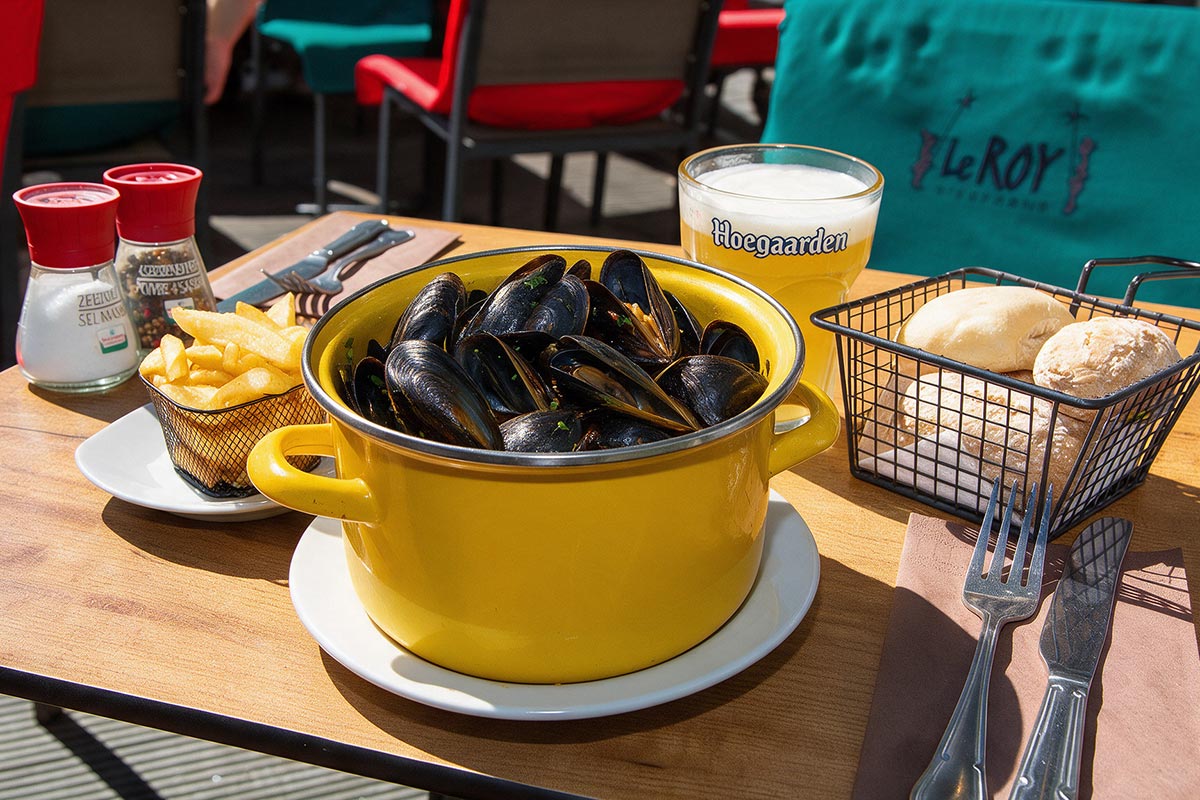
There’s no denying that moules-frites (mussels and fries, Belgium’s unofficial national dish) and Belgian beer make a great team. But a blonde ale isn’t always the best beer with mussels. Mussels in white wine and curry mussels don’t call for the same flavors, and the fries themselves have a say in the pairing too. In this article, we go beyond the generic answer and match the beer to the way the mussels are prepared. You’ll find everything you need to create a true harmony, one preparation at a time, with concrete examples for each style. Enough to turn your next pot of mussels into an unforgettable tasting experience.
Three principles for pairing beer with mussels
Before getting into the details of each preparation, it helps to understand what makes a beer and mussels pairing work. Three ideas come up almost every time, and knowing them lets you build your own pairing, even for a homemade recipe that isn’t covered here.
- Complementarity: the beer’s aromas echo those of the sauce, like the citrus notes of a witbier (Belgian white beer) that carry on the parsley and onion of mussels marinières.
- Contrast: a livelier beer cuts through the fat or richness of a creamy sauce, a bit like a squeeze of lemon on oily fish.
- The palate cleanser effect: the carbonation of a well-served beer cleans the palate between bites, a role that fries, fatty and salty as they are, really bring out.
These three principles aren’t mutually exclusive, and a single pairing can play on several of them at once. If the differences between blonde, brown, amber and white beers are still a bit fuzzy for you, our article on the main families of Belgian beer covers the basics before you go further here.
The right pairing for each mussel preparation
The choice of beer depends first on how the mussels are cooked, but your personal taste in beer obviously matters too. Plain mussels (moules nature), simply cooked in broth, are the easiest starting point for understanding these pairings. Their pure, briny flavor goes with almost any light style, from pils to witbier, which makes them a good base before exploring the bolder preparations below. Here are the five most common preparations, and the beer family that suits each one best.
Mussels marinières, witbier is the go-to
Marinières remain the most common preparation in Belgium, made with celery, onion, parsley and a knob of butter. That simplicity is exactly what calls for an equally clean beer. Witbier, brewed with wheat and spiced with bitter orange peel and coriander seeds, extends the herbal notes of the cooking broth and adds a citrusy touch of its own. Beers like Hoegaarden, Blanche de Namur or Brugs Tarwebier work particularly well here, with their lightness and slight tartness.
Serve it cold, around 3 to 4°C (37 to 39°F), to fully enjoy how refreshing it is. The dense head of a well-poured witbier also matches the texture of the broth, a detail that counts when you dip your bread in it (in the broth, that is, not in the beer 😋).
Mussels in white wine, a blonde to balance the acidity
Where marinières stick to celery and herbs, mussels in white wine get a sharper acidity and a slightly winey note in the broth. That liveliness calls for a beer with a little more roundness than a witbier, without weighing the dish down. An abbey blonde like Leffe Blonde, smooth with hints of vanilla and clove, softens the wine’s acidity while keeping the briny flavor of the mussels front and center.
If you’d rather keep things lighter, a well-chilled pils works too, this time playing on the palate cleanser effect rather than complementarity. And if you can’t decide, nothing stops you from ordering a glass of the white wine used in the cooking. It’s the most obvious pairing of all.
Curry mussels, a beer that stands up to the spices
Coconut milk and curry bring a spicy sweetness that can easily overwhelm a beer that’s too discreet. You need a bolder beer here, one that can hold a conversation with the spices instead of fading behind them. A fuller-bodied witbier is still a safe option, but a saison like Saison Dupont, with its peppery character and dry finish, pairs especially well with the heat of the curry.
If you like more pronounced bitterness, a Belgian IPA like Houblon Chouffe has enough aromatic punch not to disappear behind the spices. Here the bitterness plays a contrasting role, cutting through the richness of the coconut milk.
Mussels in cream sauce (poulettes), a rounder beer
Cream changes everything. It brings fat and roundness, which calls for a beer with enough body not to fade behind the sauce. A tripel like Westmalle Tripel, with its notes of ripe fruit and gentle spice, holds its own perfectly. A strong blonde like Duvel works on the same principle, with a slightly more pronounced bitterness that balances the fat of the cream.
On our menu, you’ll find mussels poulettes, seasoned with garlic and enriched with cream and white wine, a preparation that follows exactly the same pairing logic. Either way, it’s best to avoid beers that are too light. They’ll likely vanish behind the sauce, and all you’ll taste is the cream.
Mussels in beer, drink what you cooked with
Less common than marinières, mussels in beer are mostly a home-cooking thing, where you simply swap the white wine in the pot for beer. The broth becomes rounder and slightly malty, with a hint of bitterness depending on the style you choose. The simplest approach is to use the same beer for cooking and for drinking. An abbey blonde like Grimbergen Blonde or Leffe Blonde has enough character to stand up to the broth without ever overpowering it. A more classic Belgian amber like Palm works just as well, minus the abbey character.
One word of caution, though. Avoid overly bitter beers for cooking, because as the broth reduces, the bitterness concentrates and ends up masking the briny flavor of the mussels. Steer clear of that trap and the pairing becomes almost automatic, since the sauce and the drink already share the same aromatic base.
And what about the fries?
The mussels get most of the attention, but the fries deserve their own beer too. Fatty and salty, they mostly need a glass that cleans the palate between bites rather than a precise aromatic match.
Pils is the best option here, thanks to its lively carbonation and light bitterness that rinse the mouth effectively. It’s probably also the beer Belgians order most often with a simple paper cone of fries. If you’d rather not switch glasses during the meal, witbier remains the most versatile choice. It works as well with the mussels as with the fries, and rarely disappoints.

What if you prefer wine?
Beer doesn’t have a monopoly on moules-frites, and wine is a perfectly legitimate choice. We may be Belgian, but we’re not dogmatic about it (a friendly wink to our French neighbors 😉). A dry white such as a Muscadet or a Sauvignon Blanc works on the same principles as witbier, with a lively acidity that extends the broth and refreshes the palate between bites.
Wine’s main advantage is its versatility with classic mussels marinières, where it follows the more familiar codes of a seafood pairing. With curry or a cream sauce, however, things get trickier. You’ll need a white with a bit more body or roundness, or the wine will be completely overpowered by the sauce.
But whether you choose beer or wine, it’s always better to match the drink to the preparation rather than to the dish as a whole.
For the curious, gueuze or kriek
To go off the beaten path, some beer lovers try pairing mussels with a sour lambic beer. The sharp acidity of a gueuze (a blend of young and old lambics), like those from Boon or Cantillon, works a bit like a splash of vinegar or lemon on seafood. It’s a less classic pairing, but it has its devoted fans.
The fruitiness of a kriek (a lambic refermented with cherries), Kriek Boon for example, takes a different direction and plays more on a sweet and salty contrast. It’s not the pairing we’d recommend first, but it’s an interesting way to rediscover a dish you thought you knew well.
Our selection at Le Roy d’Espagne
You don’t need to stock up on bottles at home to try these pairings. Just come and taste them with us, right on the Grand-Place in Brussels. Our menu offers a selection of beers covering most of the styles mentioned in this article, from witbier to tripel.
Our house beer, La Roy d’Espagne, also has its place at the table next to a pot of mussels, with a profile designed to complement the restaurant’s cooking. Discover our full selection on our beers page, or ask our staff for advice directly. To understand how these styles take shape before they reach your glass, our article on how Belgian beer is brewed walks you through the whole process.
Conclusion
There’s no single right answer when it comes to the ideal beer for moules-frites. It all depends on the preparation, the seasoning, and even your own taste for bitterness or sweetness.
What matters most is thinking in terms of preparation rather than sticking to the default blonde reflex. Marinières, curry or cream sauce don’t have the same needs, and knowing that completely changes the experience at the table.
Next time you order a pot of mussels, try stepping out of your habits and testing a pairing you wouldn’t have picked on your own. And if you’re in the mood for more Belgian classics, our recipe for authentic Flemish beef stew braised in beer is waiting for you.
FAQ
- What’s the best beer for cooking mussels?
- An abbey blonde or a Belgian amber is the safest choice for cooking, as they add roundness and a malty note to the broth without overpowering it. Avoid beers that are too bitter or too high in alcohol, because as the broth reduces, the bitterness concentrates and ends up masking the briny flavor of the mussels.
- Which beer goes with mussels in cream sauce?
- You need a beer with body to stand up to the richness of the sauce. A tripel like Westmalle Tripel or a strong blonde like Duvel has enough character not to fade behind the cream.
- Should beer be served very cold with moules-frites?
- It depends on the style. Light beers like witbier or pils are best served very cold, between 3 and 5°C (37 and 41°F), to stay refreshing. Fuller styles like tripel or saison are better a little less cold, between 6 and 8°C (43 and 46°F), which lets their aromas come through.