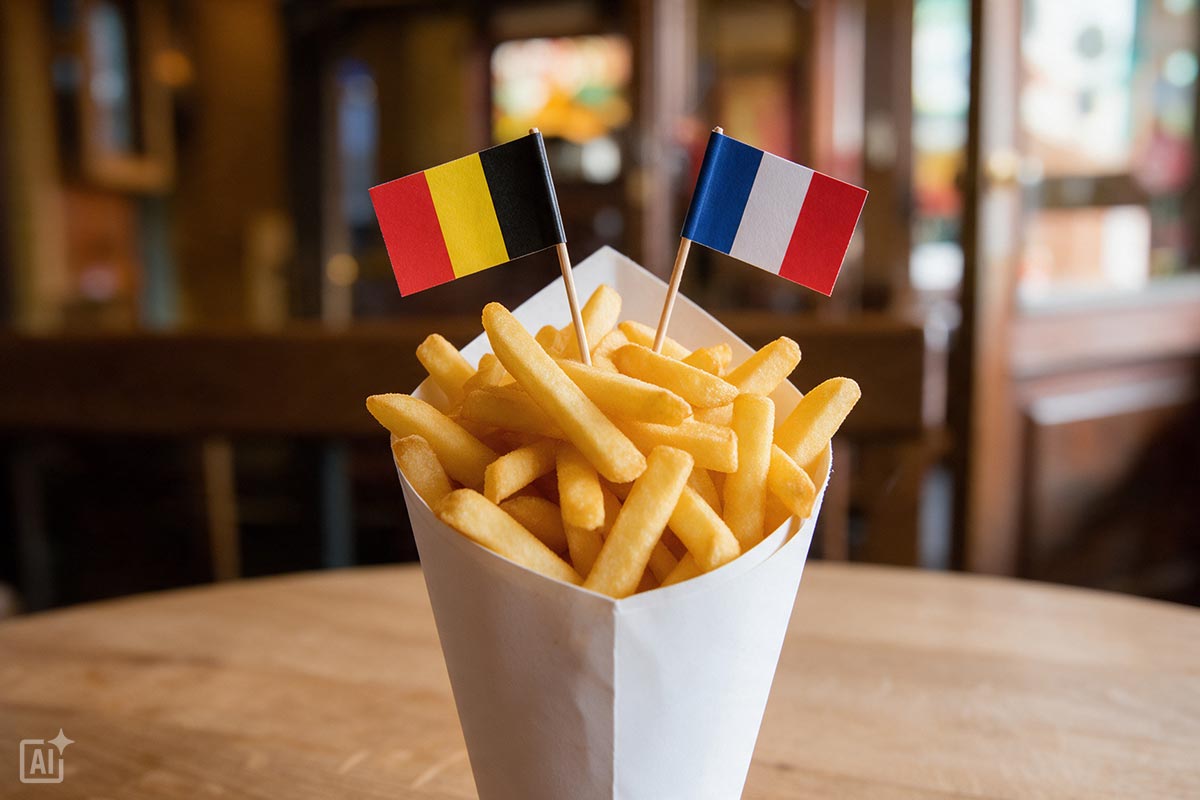
Ask any Brussels local where fries come from, and they’ll look at you as if you’d asked what color the sky is in November. Belgian, obviously. The hot paper cone, the mayonnaise on your fingers, the line outside the fritkot (a Belgian fry shack) on a Saturday night, everything seems to confirm it. Yet the origin of French fries hides a far more twisted and surprising story, with a providential manuscript, Parisian street vendors, a Bavarian musician and two overwhelmed municipal guards right in the middle of Brussels. We’ll take you from the banks of the Meuse to the Pont-Neuf in Paris, then back to the edge of the Grand-Place, to separate fact from charming fiction. Don’t worry, Belgian fries don’t come out of this investigation as losers. If anything, they gain a story even tastier than the one they were credited with.
Who invented French fries?
No point dragging out the suspense, so let’s start with the answer. According to the research of food historian Pierre Leclercq, a research associate at the University of Liège, fries were born in Paris, France, on the street, in the hands of women street vendors. Not in Namur, not in Liège, not in Brussels. Worth noting, Pierre Leclercq is Belgian himself, so no one can accuse him of picking the most “comfortable” conclusion.
His research draws on a wealth of period sources, from cookbooks and novels to plays, newspapers and engravings. On the Parisian side, traces abound from the 1830s. On the Belgian side, Pierre Leclercq found no mention of potatoes plunged into a bath of boiling fat before the mid-1840s. When it comes to the origin of French fries, the known evidence leans clearly toward France.
If so many Belgians remain convinced otherwise, it’s because of a very human confusion. Fries are so much a part of our culture today that it seems only logical they were born here. The historian speaks of a confusion between culture and origin, and that’s the thread running through this whole story. Belgium didn’t invent fries, but it turned them into an institution, which is no small thing.
The frozen Meuse legend, a story too good to be true
Before following the Parisian trail, the Belgian version deserves its due. It’s charming, it’s easy to tell, and for a long time it dominated debates about the origin of fries.
What the 1781 manuscript says
The story takes place in the Meuse Valley, around Namur, Andenne and Dinant, in what is now Wallonia, the French-speaking south of Belgium. The poorest locals used to catch small fish in the river and fry them to stretch their meager diet. One winter, the Meuse froze so hard that fishing became impossible. With no fish to be had, the locals supposedly cut potatoes into the shape of little fish and fried those instead.
The tale comes from a manuscript dated 1781, found by Belgian historian and journalist Jo Gérard while researching the Austrian Netherlands (the name for our regions under Austrian Habsburg rule in the 18th century). Jo Gérard published his find in December 1984 in the magazine Belgia 2000, with a triumphant conclusion. Belgians, he claimed, had invented fries. A month later, the Belgian weekly Pourquoi Pas? picked up the story, and the legend spread.

Why historians don’t buy it
The first problem lies in the text itself. According to Pierre Leclercq, the manuscript describes thin slices of potato pan-fried in just a little fat, a common preparation elsewhere in Europe at the time. That’s a far cry from potato sticks plunged into a deep-fat bath. In other words, even if the document is genuine, it isn’t talking about fries.
The second problem is the date. According to historian Fernand Pirotte, the potato only took root in the Namur region around 1735. That leaves time for a habit to form before 1781, but not for the versions of the legend that set the scene in the late 17th century, when potatoes weren’t yet grown there.
As for fat, it was expensive, which makes deep frying unlikely in the poorest households. Pierre Leclercq concludes that the potatoes were more likely pan-fried in very little fat, which happens to match what the manuscript describes.
What remains to be explained is how such a flimsy story held up for nearly forty years. It had everything going for it, with a frozen river, resourceful fishermen and a dose of national pride. Repeated from article to article, it eventually settled into collective memory, despite the research that contradicts it.
Where do French fries come from? Head to the Pont-Neuf
To find the cradle of fries, you have to leave the Meuse for the Seine. In the late 18th century, Paris was teeming with street vendors feeding workers, street kids and penniless artists for a few coins. Among them, women selling fried food set up their pans on the Pont-Neuf, then along the quays, on the Boulevard du Temple and outside the theaters.
Their fried potatoes quickly became the meal of choice for tight budgets. In the 1830s, novels, songs and vaudevilles (popular comic plays mixed with sung verses) featured the fried-potato seller and her hungry customers. Balzac himself slipped one into a novel. The paper cone, for its part, is recorded in Paris as early as 1837.
Here are the main milestones, in chronological order, as reconstructed by Pierre Leclercq:
- 1780s: women selling potato fritters set up shop on the Pont-Neuf in Paris.
- Around 1800: these vendors appear to be the first to drop potato slices into hot fat.
- 1830s: fried potatoes become a symbol of Parisian working-class food.
- By 1840 at the latest: the elongated shape appears in Paris, probably because long pieces stick together less than round slices.
- 1842 and 1845: the first images, by Honoré Daumier and then Charles-Joseph Traviès, show these street fries.
- 1850s: the new cut finally makes its way into cookbooks.
The stick shape only became the standard in the 20th century, though. For a long time, slices, wedges and sticks coexisted in frying pans and recipe books. So the invention of French fries wasn’t a single stroke of genius, but a slow process of trial and error by women whose names history never recorded.

1844, fries arrive in Brussels
Meanwhile, in Belgium, people were certainly eating pan-fried potatoes, but there’s no known trace of deep-fried potatoes being sold on Belgian soil. The man who brought them over was Frédéric Krieger. This Bavarian who had settled in Belgium made a living as a traveling fairground musician, and that was still his job in 1842, according to a police record unearthed by Pierre Leclercq.
Around that time, Krieger worked in a rotisserie in Montmartre, where he learned to make fries. Back in Belgium, he founded the Fritz company in 1844, set up a canvas stall and toured the fairs. His advertising promised “pommes de terre frites à l’instar de Paris” (fried potatoes the Paris way), and he never missed a chance to mention his training in the French capital. The nickname he gave himself, “Monsieur Fritz, le roi de la pomme de terre frite” (Mister Fritz, king of the fried potato), shows a real flair for marketing. He didn’t invent fries, but he was probably the first to sell them on Belgian soil.
That same year, a Paris newspaper, Le Constitutionnel, reported a remarkable scene. A merchant had just started selling fried potatoes the Paris way in Brussels, and business was so brisk that two municipal guards had to be posted to hold back the crowd. Three enormous pans were running nonstop and still struggling to keep up. The amused journalist concluded that Parisian industry would hardly complain about this imitation.
The sources don’t name the merchant. It could have been Krieger, but nothing proves it, and we’d rather not guess where the sources stay silent. One thing is certain, Brussels gave fries a triumphant welcome from day one. Krieger, for his part, made a fortune and inspired a crowd of vendors at fairs across the country.
How fries became so Belgian
Having arrived from Paris, fries could have remained a fairground novelty. Yet within a few decades, they broke free of their Parisian roots and became a marker of Belgian identity. Several habits, picked up here and then adopted nationwide, explain this transformation.
Moules-frites, from fairgrounds to Parisian posters
In the 1870s, stands selling moules-frites (mussels and fries) multiplied at Belgian fairs before settling into permanent spots in the cities. The pairing caught on so well that the French came to associate Belgians with the dish. In 1890, a Parisian cabaret poster advertising a Belgian evening was already featuring it. In an ironic twist, half a century after exporting fries, Paris already saw them as a Belgian specialty.
Moules-frites remain one of the great classics of the Belgian table, and choosing the right beer to go with them deserves as much attention as the cooking. We’ve even devoted a whole article to the best beer with mussels, depending on how they’re prepared.
Double frying, a habit turned signature
Ask a Belgian fry cook what makes a good fry, and they’ll almost always bring up double frying before they even mention the potato. The principle is simple. A first fry at a moderate temperature cooks the potato through, then a second, hotter bath makes it golden and crisp. Temperatures of around 130°C (266°F) and then 170°C (338°F) are often cited. The first written record of the method appears in a Belgian educational book published in Verviers in 1889.
Still, it’s wise to be careful before calling it a Belgian invention. Pierre Leclercq suspects professionals may already have been using it earlier, since it saves precious time at serving (the second fry takes only two or three minutes). French manuals also recommended it between the two world wars. What is Belgian, however, is having turned it into an almost sacred rule.
Mayonnaise, a Brussels touch
When it comes to sauce, Brussels has a say. Fries served with mayonnaise are reported on Place de la Chapelle, at the edge of the Marolles neighborhood, shortly before or after World War I. The habit only became widespread after 1945, though. Today, mayonnaise remains the cone’s most faithful companion, even if fritkots offer a rather impressive range of sauces.
From fritkot to intangible heritage
The fritkot (a word Brussels locals use just as readily as the Flemish do) became a gathering place in its own right during the 20th century. You’ll find every generation and every walk of life there, waiting your turn, chatting with your neighbor, eating standing up with your fingers. That atmosphere, as much as the food itself, is what makes it unique.
Defending fries took a professional turn in 1984 with the founding of the National Union of Fry Shop Owners (UNAFRI). Official recognition followed. Fritkot culture was listed as intangible heritage by the Flemish Community in 2014, the Wallonia-Brussels Federation in 2016, then the German-speaking Community and the Brussels-Capital Region in 2017. As far as we know, it isn’t on UNESCO’s intangible heritage list, unlike Belgian beer culture, inscribed in 2016, whose eight-century history we tell in another article.

Why are they called French fries?
The most popular explanation involves American soldiers in World War I. Stationed in Belgium, they supposedly tasted fries served by French-speaking Belgian soldiers and named them “French fries,” believing they were in France. It’s a nice story, and it flatters Belgian pride. Unfortunately, it doesn’t hold up.
The expression “French fried potatoes” already appears in an English cookbook, Eliza Warren’s Cookery for Maids of All Work, in the mid-1850s. The shortened form “French fry” has been used in the United States since at least 1903. So the name you grew up with was around long before American troops shipped out to Europe, and it simply refers to the French way of preparing potatoes.
The story took another twist in 2003. Angry at France’s opposition to the Iraq War, some members of Congress renamed fries “Freedom fries” in the House of Representatives cafeterias. Brussels chef Pierre Wynants, of the renowned Comme chez Soi restaurant, seized the moment and suggested calling them “Belgian fries.” The idea raised a few smiles, but Flanders’ tourism board has also championed the name.
Belgian fries vs. French fries, what sets them apart today
While their origin is Parisian, the way fries are made and eaten has taken different paths on either side of the border. In France, they usually accompany a dish, steak first and foremost. In Belgium, they can be a meal in their own right. A few trends stand out, with plenty of exceptions, of course:
- Double frying: very common in Belgian fritkots, it gives a fry that’s fluffy inside and crisp outside.
- Beef fat: many fry cooks remain loyal to blanc de bœuf (refined beef tallow), which gives a rounder flavor than vegetable oil.
- The cut: Belgian fries are generally thicker than the shoestring fries served in many French brasseries.
- The cone: they’re often eaten standing up, with your fingers or a small wooden fork, outside the fry shop or on a nearby bench.
- The sauces: mayonnaise first, but also andalouse, samurai, américaine or tartare, with the lineup varying from one fritkot to the next.
None of this is set in stone, and you’ll find excellent fries in France, especially in the north, where fry-shop culture is very close to ours. But for a Belgian, a fry that’s too thin, cooked only once and perched on the edge of a plate feels a bit like a broken promise.
On the trail of fries in Brussels
If this story has whetted your appetite for culture as much as for fries, Brussels has plenty to keep the investigation going. About 200 m (650 ft) from the Grand-Place, at 28 Rue de l’Étuve, the Frietmuseum (Brussels’ fries museum) opened in April 2025. Across three floors, it traces the potato’s journey from the Andes to the Belgian paper cone, and the visit ends with a tasting.
To move from theory to practice, the Grand-Place is never far away. At Le Roy d’Espagne, we serve moules-frites and cones of fries in a house whose history goes back much further than that of fries. A look at our menu will help you choose before you come.
Conclusion
According to the archives gathered by Pierre Leclercq, fries were born on the streets of Paris before reaching Brussels in 1844. The frozen Meuse legend keeps its charm, but it belongs to folklore.
So Belgium didn’t invent fries, but it gave them a way of life. Double frying raised to a rule, the cone devoured standing up, mayonnaise, moules-frites and fritkots, this is where all of that became a culture.
Next time a French friend teasingly reminds you that fries were born in their country, you can agree without blushing. Then invite them to taste what Belgium has made of them.
FAQ
- Which potato variety should you use for Belgian fries?
- Bintje remains the historic benchmark for Belgian fry cooks, thanks to its floury flesh, which gives a fluffy inside. It’s losing ground, though, to other varieties that are hardier or better suited to industrial production. The key is to choose a floury potato (in the US, a russet is the closest match) rather than a waxy variety meant for salads.
- How many fry shops are there in Belgium?
- Figures vary depending on the source and the year, but the National Union of Fry Shop Owners puts the number at around 5,000 fry shops across the country. Relative to the population, that’s a density few countries can match.
- When is International Belgian Fries Day?
- It’s celebrated every year on August 1, since 2008. It’s an opportunity for many fry shops to show off their know-how. In Wallonia, a Fries Week (Semaine de la frite) has also been held every fall since 2009.
- What’s the difference between fries and chips?
- The difference starts with the cut. In the early 19th century, fried potatoes were most often sliced very thin, a cut then known as “en liard” (after a small coin of the time). That cut eventually became what Americans call “chips,” while the elongated version became the fry. To complicate things, the British call fries “chips” and potato chips “crisps.”