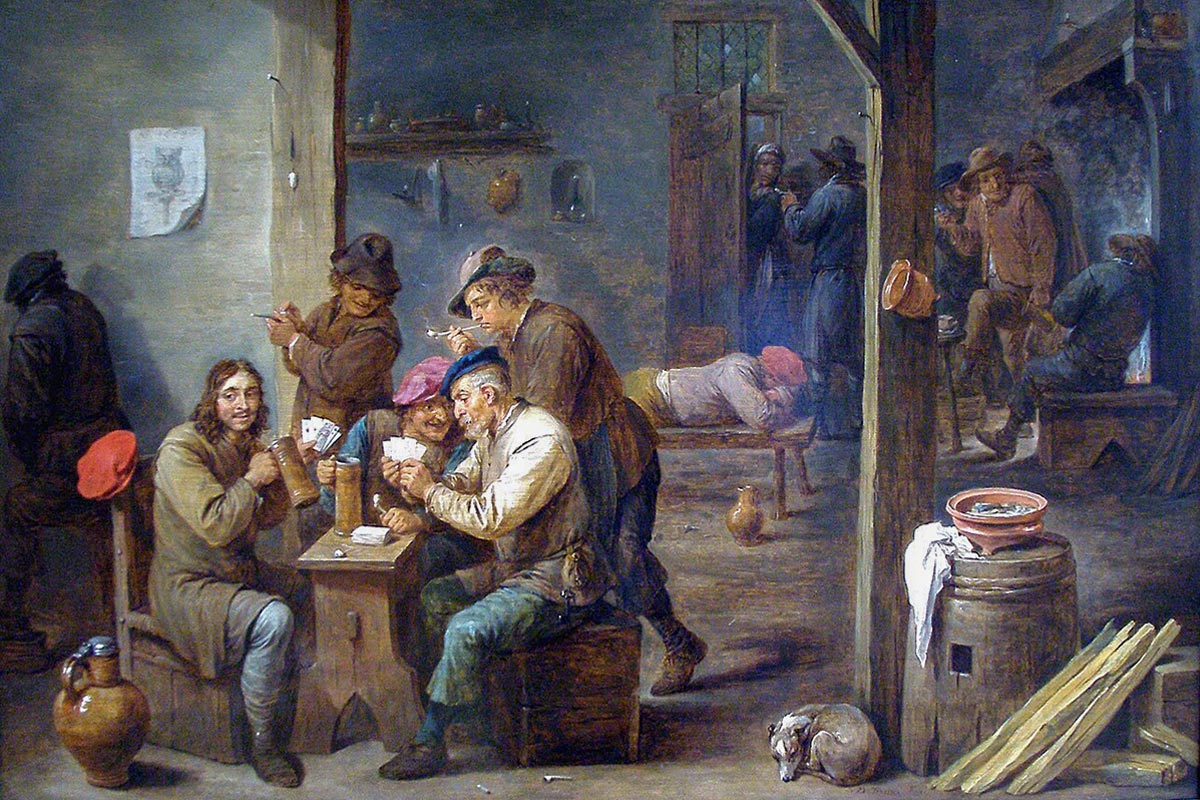
In a tavern scene painted in 1658 by David Teniers the Younger, peasants play cards with a mug of beer within reach. The painting illustrates a recent article in The Conversation about how beer wars have built and broken empires, from Rome to Budweiser1. The journey takes in Bavaria, England and Bohemia, but it barely mentions Belgium.
Quite a gap, considering that Teniers, a Flemish painter, settled in Brussels in 1651! Here too, beer was taxed, claimed by a handful of lords, defended by guilds and even blamed for drawing our borders. So we’re retracing that journey from the Belgian side, to understand how beer wars shaped Belgium. You’ll see that several of these battles played out a few steps from our terrace, on the Grand-Place, Brussels’ main square.
“Beer wars” aren’t fought only with weapons. The phrase covers any conflict where beer is the stake, whether it’s taxes, monopolies, laws or markets. Throughout history, rulers, cities and countries have fought over the money, the control and even the image of beer. The oldest of these conflicts pits the wine of the Romans against the beer of their neighbors, and our region sat right on the border between those two worlds.
The Nervii, the Belgians who turned down Rome’s wine
The Romans preferred wine, and to them beer had the reputation of a barbarian drink. Tacitus, a Roman senator and historian of the late 1st century, describes a fermented barley or wheat drink among the Germanic peoples, which he presents as a poor imitation of wine. Much later, Emperor Julian would even claim that beer smells like a goat.
Among our ancestors, the balance of power was reversed. In The Gallic War, Caesar describes the Belgians as the bravest of the Gauls, because they live far from the Roman province and merchants rarely visit them2. The Nervii, who lived between the Scheldt and the Sambre, went even further. They banned wine and luxury goods from their lands, convinced these products would soften their warriors’ courage.
What did they drink instead? Caesar doesn’t say, but in a land of grain, a homemade beer wouldn’t be surprising. Either way, shutting the door on wine meant shutting the door on Rome.
Gruit, a hidden tax on beer
After the fall of Rome, beer settles into monasteries, then into towns. And wherever beer flows, those in power always end up holding out their glass.
What is gruit?
In the Middle Ages, the beer of our regions didn’t yet taste of hops. It was flavored with gruit, an aromatic blend whose composition varied, with bog myrtle (a marsh plant with a bitter taste) in some recipes. Brewers weren’t allowed to prepare this blend themselves. They had to buy it from the holder of the gruit right, who kept the recipe secret and pocketed a tidy sum along the way. Gruit therefore worked as a hidden tax on every beer brewed.
Liège, 974, a monopoly signed by the emperor
The oldest known mention of this right takes us back home. In 974, Emperor Otto II granted the bishop of Liège a gruit right exercised at Fosses (today Fosses-la-Ville)3. The privilege then passed through the hands of lords, bishops and towns, who sometimes defended it fiercely against their neighbors. In Brabant as in Flanders, gruit became a source of income nobody wanted to give up.
Hops, a way to dodge the tax
At the end of the Middle Ages, hopped beers arrive from Hamburg and Holland. They keep better, travel farther and, above all, escape the gruit monopoly. The authorities end up adapting and tax beer itself rather than the herbs, which foreshadows our modern excise duties. Some even see this as the origin of our spiced beers4. To learn how beer is brewed today, we invite you to read our article on how Belgian beer is made.

Did beer really create Belgium?
We know Belgium didn’t invent beer, but what about the reverse? The question sounds like it came from a bar-counter debate on match night. Yet it comes from two economists at KU Leuven, Koen Deconinck and Johan Swinnen, who defended it with Eline Poelmans in an economic history journal5. Their thesis starts from a very real war, the revolt of the Netherlands against Spain (1566-1648).
At the outset, the Seventeen Provinces form a single whole under the authority of Philip II. The northern provinces rise up, while the southern ones end up staying loyal to the Spanish crown. Holding out for decades means paying soldiers, and that’s where beer enters the picture. The Dutch drank enormous amounts of it, and their towns had developed a control system that separated production, transport and sale to limit fraud.
The figures put forward by the researchers say a lot:
- First tax in Holland: during the revolt, beer taxes make up 19% of the province’s revenue, making it the top source of income6.
- Up against American silver: over the whole conflict, these taxes bring in the equivalent of 29% or 31% (depending on the source) of what Spain collects from its tax on American silver5, 6.
- A huge weight in small towns: beer can supply up to half of a town’s tax revenue.
Meanwhile, Spain struggles to pay its troops, who mutiny regularly. Several towns in the southern provinces, including Brussels, rise up too, but end up being retaken by Spanish troops. The north wins its independence and the south stays Spanish.
These Southern Netherlands pass under Austrian rule in the 18th century, then French rule, before being joined to the northern Netherlands in 1815. The 1830 revolution ends that union, and Belgium is born. The border drawn at the time of the revolt therefore paved the way, without drawing the country on its own. Beer obviously didn’t do everything, but it paid a good part of the bill.
Our house also bears the mark of that Spanish era, as we tell in the story of Le Roy d’Espagne.
On the Grand-Place, brewers made the rules
While armies fought, Brussels’ brewers were waging another, quieter war to defend their privileges. Their headquarters stood a stone’s throw from us.
A rich and influential guild
In Brussels, as in other cities, trades were organized into guilds, and the brewers’ guild held a monopoly. It set the quality and price of raw materials, the price of beer, and how it was brewed and sold. In 1421, after a revolt, the trades united into “nations” and won a seat in the city’s government, alongside the great families who had run it until then7. The brewers, grouped with the bakers (who once occupied our house), the millers and the coopers in the “nation” of Saint James, thus weigh on the city’s affairs.
After the 1695 bombardment
In August 1695, the cannons of Louis XIV, under Marshal de Villeroy, reduced the Grand-Place to ruins. The guilds then launched into a race to rebuild. The bakers rebuilt their house, the future Roy d’Espagne, in 1697. The brewers followed a year later with the Maison de l’Arbre d’Or (House of the Golden Tree), at number 10, to plans by Guillaume De Bruyn7.
The brewers’ offer for the Coudenberg
In 1731, the Coudenberg palace, residence of the governors of the Netherlands, went up in smoke. The brewers then offered to finance its reconstruction, on condition that the city abolish the taxes on beer7. The city refused, unwilling to give up 190,000 florins in annual revenue from brewing. This episode shows the weight of the guild, and of beer in Brussels’ finances.
That power ended under the Directory, at the end of the 18th century, when guilds were abolished. The Maison des Brasseurs (Brewers’ House), for its part, still houses the nonprofit Brasseurs Belges (Belgian Brewers).

Why are Belgian beers so strong?
Many explain it by the Vandervelde law of 19199, which banned distilled spirits (jenever, whisky and so on) in cafés. Its author, the socialist Émile Vandervelde, wanted to protect workers from alcoholism. Belgians then supposedly turned to stronger beers, like Westmalle’s dubbel or Moortgat’s Victory Ale (the future Duvel), although exact dates vary depending on the source. This thesis needs some nuance, though. Strong beers stayed rare for decades and only became truly popular after 1950. The law, repealed on January 1, 1984, therefore played a role, but not the only one.
The real story begins a few decades earlier, with a tax that shaped how beer was brewed for a long time, without explaining on its own how strong the beers are. In the 19th century, Belgian excise isn’t calculated on the beer sold, but on the capacity of the mash tun (the big vat where malt and hot water are mixed). This system, inherited from the Dutch period according to some historians, pushes brewers to squeeze the most out of every fill. In 1860, the state abolishes the municipal tolls (octrois), the taxes cities levied on goods coming in. To make up for it, Finance Minister Frère-Orban proposes to nearly double the excise, from 2.05 to 4 francs per hectoliter (about 26 gallons) of mash tun capacity10. Brewers then flood the Chamber of Representatives with petitions against the increase, pointing out that beer is an “essentially Belgian” industry.
Here, in short, is how all these rules shaped what you find in your glass today:
- Penalized brewing methods: a tax calculated on the mash tun made some ways of brewing more complicated, and bottom fermentation only caught on here after World War I.
- Sipping beers: deprived of jenever at the corner pub, some Belgians perhaps turned to richer beers, but historians remain divided on how big that effect was.
- Great freedom with ingredients: unlike Germany, Belgium never imposed such a strict purity law. The legal definition of beer requires hops and at least 60% barley or wheat malt, but leaves room for spices, fruit or candi sugar.
Two world wars, thousands fewer breweries
At the start of the 20th century, Belgium has more than 3,000 breweries, nearly one per village11. As soon as it arrives in 1914, the German occupier draws up a methodical inventory12, then multiplies requisitions of metals, including copper. Brewing vats probably went the same way, although precise figures are lacking. World War II in turn brings grain shortages and rationing. According to the Taymans family in Jette, the brewer had hidden his engines in barrels so the Germans wouldn’t find them13.
The decline is spectacular. Belgium drops from 3,223 breweries in 1900 to 1,546 in 1930, then to 414 in 196014. The two wars, the economic crisis of 1929 and the rise of large industrial breweries explain this fall.
The revival comes first from a few enthusiasts. In Hoegaarden, the last white beer brewery closes in 1957. In 1966, a local milkman, Pierre Celis, revives the recipe with makeshift equipment15. The movement only gains real momentum from 1975, and especially in the 1990s11.
Brussels illustrates this concentration well. Belle-Vue was born from a café where Philémon Vanden Stock blended lambics. In 1943, the family bought the Vos-Kina brewery in Molenbeek, then after the war pushed a sweeter, pasteurized gueuze sealed with a crown cap. In 1949, a heat wave made millions of bottles of gueuze explode at its competitors, while its own held up16. Belle-Vue then absorbed its Brussels rivals, and by 1986 only three breweries remained in the capital17.

The Reinheitsgebot, a border closed to Belgian beers
The Conversation article cited in the introduction devotes a long passage to the Bavarian beer purity law of 1516, the famous Reinheitsgebot. Seen from Belgium, this law mostly served as a barrier. By reserving the name “Bier” for drinks made from barley, hops, water and yeast, Germany effectively closed its market to a good share of our beers.
Kriek and witbier with coriander, for example, couldn’t be sold there as beer, since the German law in force, heir to the 1516 one, required specific ingredients. It took a ruling by the Court of Justice of the European Communities on March 12, 1987, to force Germany to accept beers legally brewed in other member states18. Our beers thus earned their place on German shelves, even though many consumers remain loyal to their 1516 law.
The beer wars aren’t over
Beer is still a matter of taxes, power and pride today. Three recent episodes show it:
- French excise duties of 2012: France raises its excise on beer by more than 160%, without touching wine. The Belgian Senate unanimously passes a protest resolution, because France alone absorbs nearly a third of our brewers’ exports19.
- The “beer mug war” (la guerre de la chope): from 2013, the Belgian tax authority counts 192 glasses per 50-liter (13-gallon) keg to calculate a flat-rate VAT. Café owners argue, with bailiff reports to back them up, that they only get 168. In October 2024, the Council of State annuls the contested decree, criticizing the method without ruling on the figures20, 21. Since then, the flat rate has been tolerated pending a new decree, then extended until December 31, 2026 by a royal decree of May 7, 202622.
- AB InBev, an empire born in Leuven: the group descends from Interbrew, formed from the merger of the Artois brewery in Leuven and Piedboeuf in Jupille. Renamed InBev, it buys Anheuser-Busch in 2008 and becomes the world’s largest brewer. Along the way, it inherits the Budweiser quarrel told by The Conversation23.
Conclusion
From the land of the Nervii to the offices in Leuven, beer has always been a matter of power in Belgium. It enriched bishops, paid for a good part of a revolt and left its mark even on the facades of the Grand-Place. These wars have never completely stopped, and France, the Belgian tax authority and AB InBev still supply new episodes.
This history can still be read in the stones of the Grand-Place. The Maison des Brasseurs and Le Roy d’Espagne, the former bakers’ house, have stood facing each other on the same square for more than three centuries.
FAQ
- Why do people talk about the “beer war”?
- The phrase is a figure of speech. It covers conflicts where beer is the stake, even when nobody takes up arms. These conflicts are about taxes, laws or brands, like the Budweiser quarrel or the “beer mug war” between Belgian café owners and the tax authority. At certain times, beer has also helped finance real wars, like the revolt of the Netherlands against Spain.
- Can you visit the Maison des Brasseurs on the Grand-Place?
- Yes. The Maison de l’Arbre d’Or, at number 10, houses a small museum of Belgian brewers in its vaulted cellars. You’ll see old brewing equipment and the story of the guild, a few steps from our terrace.
- Does gruit still exist today?
- It has disappeared from everyday production, but a few craft brewers, in Belgium and elsewhere, are brewing gruit beers again, sometimes without any hops at all. They remain rare and are mostly tasted out of curiosity, to get a feel for the beers of the Middle Ages.
- Is beer still taxed in Belgium?
- Yes, beer is subject to excise duties, like wine and spirits. In 2015, for example, the state hit spirits much harder than beer24.
- What is the oldest brewery in Brussels still operating?
- Cantillon, located in Anderlecht, is often presented as the oldest brewery in the city (it was founded in 1900). It began by blending lambics, and has brewed its own lambic since the late 1930s. It still makes gueuze today through spontaneous fermentation, thanks to the microorganisms in Brussels’ air.
- Why do some Belgian beers contain spices?
- Unlike Germany, Belgium never imposed such a strict purity law. The legal definition of beer requires hops and at least 60% barley or wheat malt, but leaves brewers room to add spices, fruit or candi sugar. Some also see a legacy of gruit here, as if our spiced beers were a survival of that herb blend.
Article sources
- Lead image : Tavern Scene, David Teniers the Younger, 1658 (cropped). Photo taken at the National Gallery of Art in Washington, D.C., United States. Credit: Wikimedia (Public Domain).
- The Conversation : “De Rome à nos jours, les guerres de la bière ont créé et défait les empires” (in French), October 31, 2026.
- Julius Caesar : The Gallic War, Book I, chapter 1, and Book II, chapter 15.
- Wikipedia (EN) : “Brewing right”.
- RTBF : “3 choses à savoir sur l’origine des bières épicées” (in French).
- Deconinck, Poelmans and Swinnen : “How Beer Created Belgium (and the Netherlands)”, Business History, vol. 58, 2016 (29%).
- The Conversation (EN) : “How beer created the state of Belgium” (19% and 31%).
- Brussels Beer City : “A History of Brussels Beer in 50 Objects, #9 Brewers’ Oath”.
- Urban.brussels, protected heritage register : Maison des Brasseurs, Grand-Place 10 (in French).
- Lost Beers : “Fact check: the Vandervelde Law”.
- Chamber of Representatives : brewers’ petitions on beer legislation (in French), session of January 31, 1865.
- Wallonia-Brussels Federation : recognition file “Culture de la bière” (in French), 2022.
- L’Avenir : “Une brochure pour évoquer mille ans de tradition brassicole à Mont-Saint-Guibert” (in French), October 12, 2021.
- L’Avenir : “La belle histoire de la Brasserie Taymans, 6 frères ressuscitent la gueuze de leur bon-papa à Jette” (in French), March 30, 2023.
- Springer : change in the number of Belgian breweries (3,223 in 1900, 1,546 in 1930, 414 in 1960), chapter 5 of a book, DOI 10.1007/978-3-319-58235-1_5.
- Beer & Brewing : “Celis, Pierre”.
- Brussels Beer City : “A History of Brussels Beer in 50 Objects, #28 Gueuze Belle-Vue”.
- Brussels Beer City : “A History of Brussels Beer in 50 Objects, #33 Jaar van het Bier Tankard”.
- Court of Justice of the European Communities : judgment of March 12, 1987, case 178/84, Commission v Germany.
- La DH : “Le combat de Di Rupo pour la bière” (2012, 160%, in French) and “LOI n° 2012-1404 du 17 décembre 2012 de financement de la sécurité sociale pour 2013” (in French).
- La Libre : “Fin de la guerre de la chope” (in French), November 27, 2024.
- Council of State : judgment no. 261.103 of October 18, 2024 (ECLI:BE:RVSCE:2024:ARR.261.103, in French).
- Forum for the Future : “Régime forfaitaire de taxation pour les cafetiers prolongé fin 2026” (in French).
- La Libre : “L’accord secret entre Artois et Piedbœuf, à l’origine du numéro 1 mondial de la bière” (in French), January 22, 2020.
- spiritsEUROPE : Belgian excise increase of November 2015.