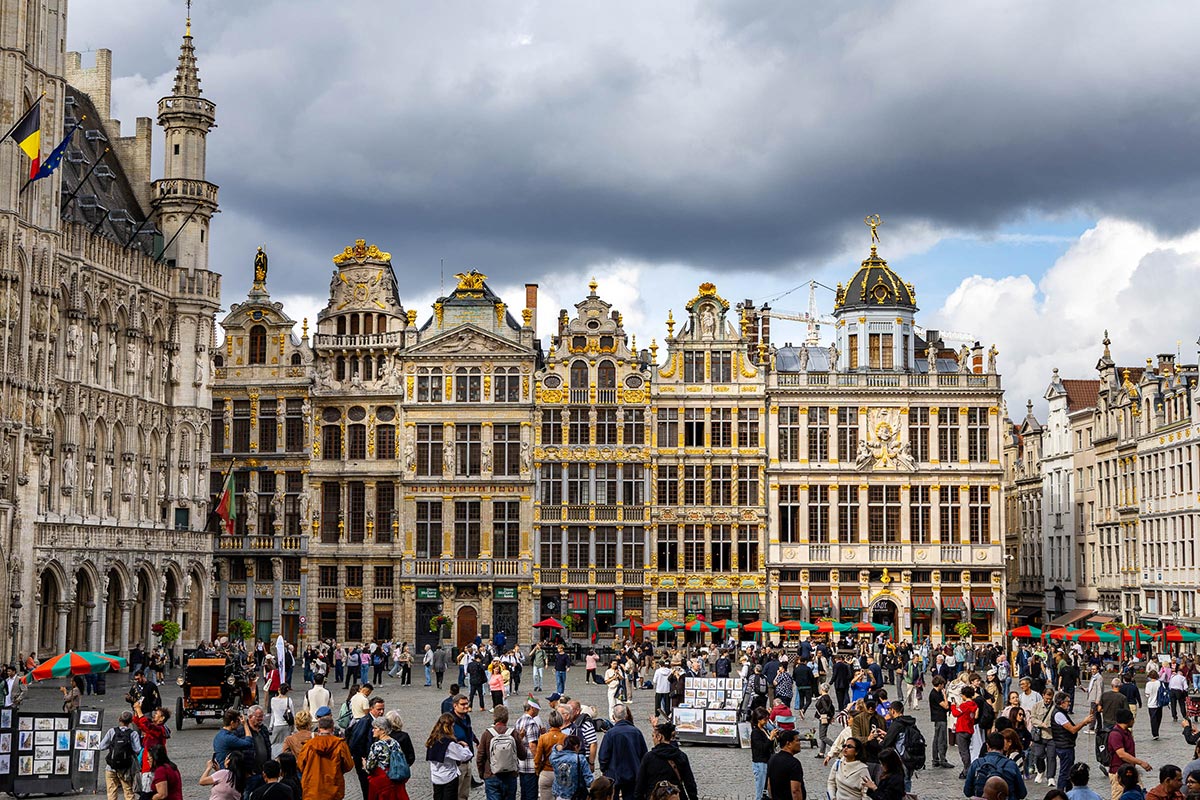
Every year, millions of visitors look up at the golden facades of the Grand-Place without knowing what those buildings are actually saying. Behind these carved gables are bakers, boatmen, tailors, and brewers, each guild leaving its own mark on the house it built. Some facades belonged to wealthy merchants, others to entire trade guilds, and all of them had to be rebuilt after a dramatic chapter in Brussels’ history.
A phoenix rises from its ashes on one facade, a compass sits above a globe on another, and a ship’s stern crowns the gable of a third. The whole square is a UNESCO World Heritage Site, right in the heart of historic Brussels. We’ll take you through the Grand-Place’s most iconic houses, including Le Roy d’Espagne itself, so you can see what these old stones are really telling you. Next time you’re standing on the square, you’ll be looking at it with new eyes.
Who owned the houses on the Grand-Place?
The Grand-Place never belonged entirely to the city’s trade guilds. Some houses were owned by guilds, the professional associations that brought together craftsmen from the same trade, while others belonged to civic militias known as serments, or simply to wealthy private citizens. Le Roy d’Espagne, for instance, belonged to the bakers’ guild, while La Louve belonged to the Archers’ Guild. Other houses, like Le Heaume or La Rose, remained private residences with no guild connection at all.
The square’s current appearance owes everything to one tragic episode. In August 1695, artillery under King Louis XIV, commanded by Marshal de Villeroy, bombarded Brussels for three days straight. The resulting fire destroyed nearly every house around the square, sparing only the facade and tower of the Town Hall, which the French gunners had used as their aiming point. Thousands of houses burned across the city.
The rebuilding effort moved remarkably fast, driven by a shared sense of purpose. An ordinance issued on April 24, 1697 set strict rules for the reconstruction and required a consistent architectural style across all the facades, which is exactly why the square still feels so harmonious today despite having so many different owners. Most of the houses you see now date from that lightning fast rebuild at the end of the seventeenth century, in a Flemish Baroque style with a touch of Italian influence.
How to read a Grand-Place facade
With so much carved detail, it’s not always obvious where to look first. A few simple cues are enough to decode the essentials of a facade, even if you know nothing about architecture. Here’s what to look for before moving on to the next house:
- The sign: the name that gave the house its identity, usually shown above the door or on the pediment, like the golden fox at number 7.
- The patron saint: every trade honored a protector, carved up near the roofline, such as Saint Giles for the grocers or Saint Nicholas for the mercers.
- The tools of the trade: compasses, hammers, or other specific instruments, quietly carved into the stone to mark the guild that owned the house.
- The chronogram: a Latin inscription where certain capitalized letters, read as Roman numerals, add up to a date.
- The gilding: added mostly during the nineteenth century restorations, it highlights the statues and the most symbolic ornaments.
With these cues, you can spot which trade a house belonged to in a matter of seconds, even when that trade disappeared centuries ago.
The west side, six must-see facades
Coming from the Rue au Beurre, you’ll find six houses lined up along the entire west side of the square. Each one has its own story to tell, from the bakers at number 1 to the mercers at number 7.
Le Roy d’Espagne, the bakers’ house
At number 1, the house known as Le Roy d’Espagne belonged to the powerful bakers’ guild. Built in 1696, it was entirely rebuilt in 1901 and 1902 after decades of decline, and it still carries the busts of Saint Aubert, patron saint of bakers, and Charles II, the Spanish king who gave the house its name. Today it’s home to our own brasserie-restaurant, where the building’s history keeps getting told over a meal. For more on the eight centuries between the house’s first mention and the building you see today, our page on the history of Le Roy d’Espagne covers the whole story.

La Brouette and Le Sac
Right next door, at numbers 2 and 3, La Brouette (“The Wheelbarrow”) belonged to the grocers’ guild, the merchants who sold eggs, poultry, and butter on the square. Built in stone as early as 1644, its facade partly survived the 1695 bombardment before being rebuilt two years later under the direction of Jean Cosyn. A statue of Saint Giles, patron saint of the grocers, still watches over the top of the gable.
At number 4, La Maison du Sac (“The Bag House”) belonged to the cabinetmakers and coopers, whose tools still decorate the facade today. Only the lower part survived the 1695 fire; cabinetmaker turned architect Antoine Pastorana rebuilt the upper floors in 1697, topped with a richly carved gable end. A globe with a compass resting on top crowns the whole thing, a subtle nod to the precision woodworking the trade demanded. Today the house is home to a space dedicated to Belgian master chocolatiers.
La Louve and its phoenix
La Louve (“The She-Wolf”), at number 5, belonged to the Archers’ Guild, one of the city’s defensive militias. Built in 1690, its facade was rebuilt in 1696 with a horizontal cornice topped by a phoenix rising from its ashes, a symbol deliberately chosen to represent Brussels’ own rebirth after the bombardment. The relief above the door shows Romulus and Remus being suckled by a she-wolf, a direct nod to the house’s name. The original drawings were restored at the end of the nineteenth century by city architect Victor Jamaer.
Le Cornet, a ship’s stern up top
Number 6, Le Cornet (“The Horn”), was home to the boatmen’s guild from the fifteenth century onward. Rebuilt in 1697 by architect Antoine Pastorana, it stands out for its gable carved into the shape of a ship’s stern, a direct reference to its owners’ trade. The boatmen’s guild leaders entrusted the entire facade’s sculpture to Pierre van Dievoet, whose signature appears on several other houses around the square.
Le Renard, the mercers and the four continents
The last house in this row, Le Renard (“The Fox”), at number 7, belonged to the mercers’ guild, merchants who traded in all kinds of small goods. Rebuilt in 1699, its facade features bas-reliefs of the four continents known at the time, a none too subtle display of the guild’s commercial ambitions. Saint Nicholas, patron saint of the mercers, sits at the very top of the building, while a golden fox sign hangs above the entrance.

Le Cygne and L’Arbre d’Or, butchers and brewers
On the south side of the square, two houses stand out for their especially eventful histories. At number 9, Le Cygne (“The Swan”) started out as an inn before being rebuilt in 1698 for financier Pierre Fariseau, who had his own monogram added to the facade. The butchers’ guild bought the house in 1720 and remodeled the upper part of the facade using the proceeds from the wool trade.
Le Cygne owes some of its fame to an unexpected regular. Karl Marx, who was living in Brussels at the time, spent New Year’s Eve there on the night of December 31, 1847 into January 1, 1848, alongside German workers’ associations and democratic groups. That same house also hosted the founding congress of the Belgian Workers’ Party in April 1885. Legend has it that the Communist Manifesto was written there; the historical record only confirms that Marx spent time at the address, not that he wrote the text within its walls.
Right next door, at number 10, L’Arbre d’Or (“The Golden Tree”) remains the only house on the square still connected to its original trade. This former brewers’ guild house is now home to the Brewers’ Museum, and part of the building still houses the offices of the Belgian Brewers’ Confederation. The facade itself is decorated with sculptures by Marc de Vos and Pierre van Dievoet, and topped with an equestrian statue of Charles Alexander of Lorraine, put up in 1752. A local legend credits architect Guillaume de Bruyn with a famous line spoken during construction, reminding the brewers they were building for eternity. If you want to dig deeper into that brewing tradition, our articles on the history of beer in Belgium and how it’s brewed cover eight centuries of know-how.

The House of the Dukes of Brabant, seven houses behind one facade
On the east side of the square, a single facade actually hides seven separate houses. Designed around 1697 and 1698 by city architect Guillaume de Bruyn, it was altered in 1770 by Laurent-Benoît Dewez and restored between 1881 and 1890 by Victor Jamaer. The whole ensemble takes its name from the nineteen busts of Dukes of Brabant along the first floor pilasters, destroyed during the French Revolution and recarved at the end of the nineteenth century.
Each of the seven houses still keeps its own name and, in some cases, its own trade. Here are the seven addresses that make up this monumental block, from number 13 to number 19:
- La Renommée (“Fame”): a private house whose pediment holds a gilded statuette of Fame, added in 1899.
- L’Ermitage (“The Hermitage”): a former city property, sold in 1696 to help fund the Town Hall’s reconstruction.
- La Fortune (“Fortune”): once home to the tanners’ guild, also sold off by the city in 1696.
- Le Moulin à Vent (“The Windmill”): the millers’ house, easy to spot thanks to the windmill carved into its door.
- Le Pot d’Étain (“The Pewter Pot”): home to the carpenters and wheelwrights, built under the same great arched pediment as its neighbor.
- La Colline (“The Hill”): house of the Four Crowned Martyrs’ guild, which brought together sculptors, masons, stonecutters, and slaters.
- La Bourse (“The Purse”): the last of the seven houses, also sold by the city in 1696.
This shared architecture says a lot about the logic behind the post 1695 rebuild; rather than letting each owner build in isolation, the city imposed a single facade that gives this stretch of the square the feel of a palace.

La Chaloupe d’Or and Le Pigeon, tailors and painters
Two neighboring houses, at numbers 24 through 27, show just how varied the trades on the square really were. La Chaloupe d’Or (“The Golden Boat”), rebuilt in 1697 in a classicizing Baroque style, belonged to the tailors’ guild. Saint Homobonus, patron saint of tailors, sits at the very top of the facade, a fitting choice for a trade that took its patron saint seriously.
Next door, Le Pigeon belonged to the painters’ guild from the fifteenth century until the guild sold the building in 1697 to stonemason and architect Pierre Simon, who most likely designed the facade you see today. The house owes part of its fame to a rather famous exile. Victor Hugo stayed there in 1852, during his exile in Brussels following Napoleon III’s coup, before moving on to Jersey and then Guernsey.
These two neighboring facades are a good reminder that Brussels’ guilds went well beyond food and construction trades. Tailors and painters alike had enough social standing to build themselves houses to match their place on the Grand-Place.

The private houses that complete the picture
Not every facade on the Grand-Place belonged to a guild. On the north side, houses like Le Heaume (“The Helmet”), Le Paon (“The Peacock”), and the pair formed by Le Petit Renard and Le Chêne remained private residences with no guild connection at all. Their more restrained facades, also rebuilt after 1695, were a deliberate contrast to the flamboyance of the neighboring guild houses.
On the south side, in the same row as Le Cygne and L’Arbre d’Or, La Rose and Le Mont Thabor follow the same pattern right after L’Arbre d’Or, at numbers 11 and 12. These private homes round out the architectural ensemble without ever having hosted a single guild meeting, proof that the square has always mixed organized economic power with private fortunes.

Our tips for admiring the facades
Spotting all these details takes a bit of a method, especially once the square fills up with visitors during the day. A few simple adjustments go a long way toward getting the most out of the facades.
- Go in the late afternoon: the low, raking light brings out the relief of the carvings and the gilding, especially on the west facing facades.
- Step back toward the middle of the square: details up high, like statues and pediments, are easier to make out from a bit of distance.
- Walk the square counterclockwise, starting from the Rue au Beurre: that order follows the logic of the house numbering.
- Bring binoculars or a zoom lens: some bas-reliefs, especially on Le Renard and L’Arbre d’Or, are hard to make out with the naked eye.
One more thing: if your visit lines up with the flower carpet, which goes up every other year in mid-August, you’ll get a whole different angle on the facades while you’re at it.
Conclusion
The Grand-Place is a lot more than a gilded postcard. Every facade tells the story of a trade, a family, or a specific chapter of the rebuilding that followed the 1695 bombardment. Bakers, boatmen, tailors, and brewers all left a legible trace for anyone willing to take the time to look up.
Once you know how to read it, the whole way you move through the square changes. A simple walk between two stops turns into a chance to spot a phoenix, a compass, or a carved ship’s stern in the stone, all the small details that a rushed pace tends to miss.
Le Roy d’Espagne sits on one of these history laden facades, right at number 1 on the square. We’d love to have you stop by to keep the visit going over a plate of food or a good Belgian beer, just steps from the facades you’ve just discovered.
FAQ
- How many houses line the Grand-Place in Brussels?
- The numbering runs from 1 to 39. Some buildings, like the House of the Dukes of Brabant, group several addresses behind a single facade, so the actual number of individual houses is lower than the address count alone would suggest.
- Can you go inside the houses on the Grand-Place?
- A few of the houses can be visited, like the Brewers’ Museum inside L’Arbre d’Or or the Brussels City Museum inside the King’s House. Most of the other facades today house shops, restaurants, or private apartments.
- Why are the facades on the Grand-Place covered in gold?
- Most of the gilding you see today comes from restorations carried out at the end of the nineteenth century, led by the City of Brussels. It highlights the statues, signs, and other carved details, bringing back some of the shine they had lost over the centuries.
- Since when has the Grand-Place been a UNESCO World Heritage Site?
- The Grand-Place joined the UNESCO World Heritage List in 1998, in recognition of the richness and architectural harmony of its Baroque ensemble.
- What happened to the trade guilds?
- The guilds gradually disappeared following the French Revolution, which abolished trade corporations across territories under French control. Their houses have changed hands many times since, but nearly all of them still carry the name and symbols of the trade that built them.
Photos for this article: Pierre Fera