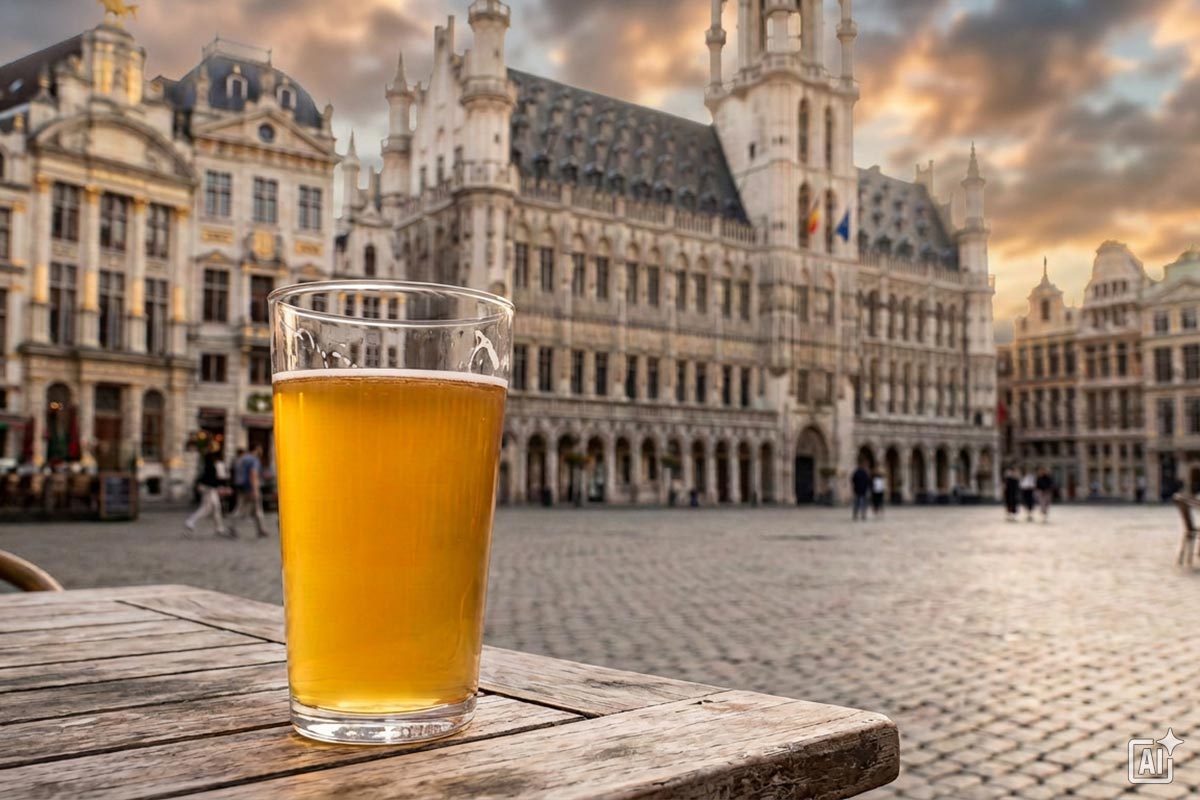
When you think of beer in Brussels, you probably picture a Trappist in a stemmed glass or an ice-cold blonde on a terrace. Yet the typical Brussels beers are somewhere else entirely, and they’re unlike anything you’ve tasted before. They’re lively, refreshing, a little cloudy, and they almost always surprise you with the very first sip. They’re also the beers Brussels locals drank almost exclusively until the middle of the 19th century, long before blonde beer took over the cafés.
Before you walk into a brasserie in the city, it helps to know what’s being poured and what makes these beers so special. In this article, we cover the three classics to know, a simple guide to choosing by taste, the brewers reinventing them today, and the house beer. Don’t worry, no technical knowledge required.
Lambic, the pillar of Brussels brewing tradition
It all starts with lambic. This beer is brewed without adding yeast (the tiny organism that turns sugar into alcohol). Fermentation happens all by itself, thanks to the wild yeasts floating in the air, which explains its distinctive taste.
Lambic comes from the Senne Valley, south of Brussels, and from the Pajottenland, west of the city. Until the middle of the 19th century, it was almost the only beer brewed in the capital, by more than a hundred small breweries. Brussels locals mostly drank lambic and faro, until the arrival of pils, with its beautiful head of foam. Served on its own, lambic is cloudy, almost flat and very tart, and you mostly find it in a handful of cafés. It’s the base beer, the one used to make gueuze, kriek and faro.
One small caveat. Today, part of the lambic is brewed outside the Brussels-Capital Region, in the neighboring countryside. So when we talk about Brussels beer, we mean a tradition of Brussels and its region, not always a beer brewed within the city walls. For the rest of the story, we wrote a whole article on the history of beer in Belgium.
Gueuze, kriek and faro, the three classics to know
In Brussels cafés, lambic gets transformed, blended or flavored. That’s where the three big names to remember come from.
Gueuze
Gueuze isn’t brewed, strictly speaking, it’s blended. The blender (the person who tastes the barrels and dials in the mix) combines young lambic, one year old at most, with older lambic, two to three years old, much like blending wines. The blend then referments in the bottle, which gives it fine bubbles. It was born in Brussels in the late 19th century, as pils was gaining ground.
The result is dry, tart, with a slight bitterness, and it surprises. At our place, it’s the Oude Gueuze Boon, at 7% ABV. It comes from the Boon brewery in Lembeek, south of Brussels in Flemish Brabant, the village lambic supposedly takes its name from, according to the brewery itself. The name “Oude Geuze” (the Flemish spelling of the label) is protected in Europe under the Traditional Specialty Guaranteed label.
Kriek
Kriek is lambic left to macerate with sour cherries. It’s deep red and fruity, but an old-school kriek stays pleasantly tangy. Many of the krieks sold today are, by contrast, much sweeter and softer.
The Belle-Vue Extra Kriek on our menu (4.1% ABV) is one of those. The brand was born in Molenbeek in 1913 and is now brewed in Sint-Pieters-Leeuw, in Flemish Brabant. Its sweetness appeals to anyone who steers clear of tartness.
Faro
Faro is lambic sweetened with brown candi sugar, which gives it a slightly caramelized flavor. Originally, it was the everyday beer of Brussels locals, much easier to drink than a gueuze. It has become rarer over time. You won’t find it on our menu, but you can taste it just around the corner at the café À La Mort Subite, on Rue Montagne aux Herbes Potagères, which serves it on draft.

Which Brussels beer should you pick for your taste?
Staring at a menu, the hardest part is choosing. Here’s a simple guide, based on what you usually like.
- If you like it dry and tart, go for a gueuze. It’s closer to a dry cider or a dry white wine than to a regular beer.
- If you prefer fruity, go for a kriek. The cherries bring fruit and a pretty red color, but an old-school kriek keeps its tartness.
- If you want sweet and easy, try a faro, or a sweetened kriek like the Belle-Vue Extra Kriek.
- If you don’t like tartness, skip lambic this time and order La Roy d’Espagne, our easy-drinking blonde. And if curiosity gets the better of you, try the Oude Gueuze Boon afterwards, which has a rather gentle tartness.
Brussels’ beer scene today, from Cantillon to Brussels Beer Project
Cantillon is the city’s landmark. This family-run brewery, founded in 1900 in Anderlecht (a Brussels municipality), still brews the old-fashioned way and houses the Musée Bruxellois de la Gueuze (Brussels Gueuze Museum). For a long time, it was the only lambic brewery still operating in Brussels. It’s about 1.5 km (0.9 miles) from the Grand-Place, and the visit ends with a tasting.
The revival came later, with so-called craft beer (small-batch, often hoppy and inventive). A dozen or so young breweries are revisiting the classics today, and Brasserie de la Senne, based near Tour & Taxis, is the pioneer. It brought bitterness back into fashion with beers like Zinnebir and Taras Boulba, hoppy with a fresh bitterness, and far more approachable than a lambic if you don’t like tartness. Its entire permanent range is now organic.
Brussels Beer Project followed in 2013 on Rue Dansaert, with bolder beers like Delta IPA or Babylone, brewed with bread. Since 2021, the brewery has also been working on lambics brewed on site. Proof that Brussels keeps inventing its beers.
La Roy d’Espagne, the house beer
One beer here carries our name. Our owner, Jean-Philippe Bosman, took over the house in 2015 with one idea in mind, to create his own beer. He met Alexandre Dumont of the Brasserie de Jandrain-Jandrenouille, and the adventure began.
La Roy d’Espagne draws its inspiration from our house, and its black label features two figures carved in wood, halberds in hand, which you’ll find at the foot of the staircase in our dining room and in our logo. One important detail, our beer isn’t brewed in Brussels but in Walloon Brabant, even though it was born on the Grand-Place.
It’s an organic, gluten-free blonde thanks to buckwheat, at 6.5% ABV, easy to drink and very refreshing. To learn more, check out the page on La Roy d’Espagne beer or browse our other beers.

Where to try these beers near the Grand-Place
We serve two members of the lambic family, the Oude Gueuze Boon and the Belle-Vue Extra Kriek. You’ll find them on our menu, in a house where several rooms overlook the Grand-Place.
To go further, the Cantillon brewery is well worth the trip, and several shops around town sell Brussels beers to take home. And if you’d like to book a table or organize an event with us, feel free to get in touch.
Conclusion
Typical Brussels beers come down to a handful of names, lambic, gueuze, kriek and faro. They were born in the Senne Valley, but pils, with its beautiful head of foam, conquered the cafés, and the lambic breweries closed one after another, until only Cantillon was left in Brussels for a long time. Today, a new generation of brewers is bringing them back into fashion, and unsweetened gueuzes, long neglected, are returning to menus. They’re not for everyone, and that’s exactly what makes them interesting.
If you’re on the Grand-Place, try a gueuze or a kriek at our place, with the square as your backdrop. And if the tartness makes you wince, there’s always La Roy d’Espagne, far more mellow.
FAQ
- Why is gueuze nicknamed the “champagne of Brussels”?
- It’s compared to champagne for its fine bubbles, its low sweetness and the art of blending that brings it to life. It’s also a beer that ages well, keeping for a long time in the bottle, a bit like a good wine.
- Is gueuze more expensive than a regular beer?
- Often, yes, because it takes several years of maturing and a blend of lambics of different ages, which costs time and work. The exact price depends on the producer, the format and the place, and you’ll find our current prices on our menu.
- Can you visit a lambic brewery in Brussels?
- Yes, in Anderlecht. The Cantillon brewery can be visited and houses the Musée Bruxellois de la Gueuze, with a tasting at the end. Check the opening hours and closing days on its website before you go.
- Where can I buy Brussels beers to take home?
- The city has several specialist shops. Beer Mania, in Ixelles, offers more than 400 Brussels and Belgian craft beers. The Biertempel, right in the center and a few steps from the Grand-Place, is known for its specialty beers.